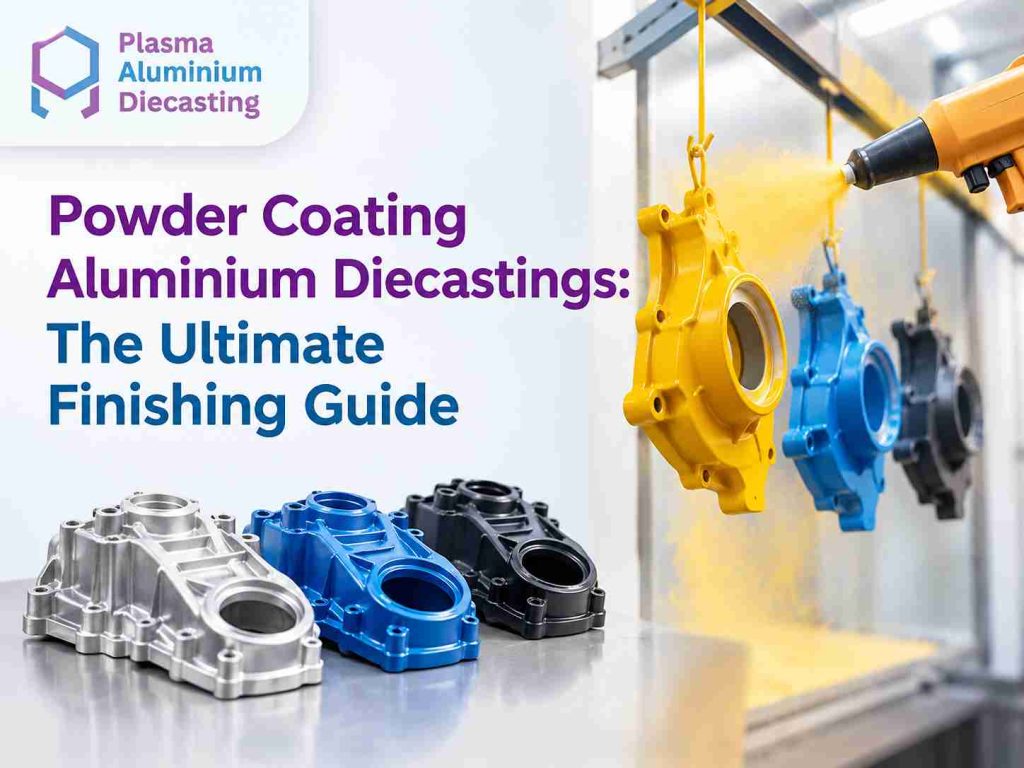
Powder coating aluminium diecastings has become one of the most reliable ways to protect and finish metal components. A freshly cast part might have the right shape and strength. But without proper surface treatment, it stays vulnerable to corrosion and scratches. The finish can also look unfinished rather than production ready.
This guide walks through how powder coating aluminium diecastings actually works. It covers why the process pairs so well with aluminium die casting. It also explains what to look for when choosing a finishing partner.
What Is Powder Coating Aluminium Diecastings?
Powder coating is a dry finishing process. Finely ground particles of pigment and resin pick up an electrostatic charge and spray onto a metal surface. The charged powder clings to the grounded part. Once the coating covers the surface evenly, the component moves into a curing oven, where heat melts the powder into a smooth, continuous film. The Powder Coating Institute maintains detailed technical standards for application methods, film thickness, and performance testing that most professional finishing facilities follow.
For aluminium die cast parts specifically, this process creates a tougher finish than traditional liquid paint. The cured powder forms a thicker, more uniform layer. It resists chipping and fading far better over time.
Why Powder Coating Works So Well With Aluminium Die Casting
Aluminium’s natural properties make it an excellent base for powder coating. The metal accepts the electrostatic charge cleanly. This helps the powder adhere evenly across complex shapes, including the intricate geometry die casting is known for producing. A spray gun and liquid paint often struggle to coat deep recesses, fine ribs, and mounting features evenly. Powder coating’s electrostatic process covers these areas far more consistently.
This combination matters a lot in industries where both function and appearance count. Automotive brackets, electrical enclosures, and consumer product housings all benefit from powder coating aluminium diecastings. The process protects the underlying metal. It also gives the part a clean, professional look straight off the line.
The Powder Coating Process Step by Step
Understanding each stage of powder coating aluminium diecastings helps explain why the finish holds up so well.
Surface Preparation
Before applying any coating, the part needs thorough cleaning. This removes oils, mould release residue, and any oxidation from the casting process. Most facilities combine degreasing with chemical or mechanical pretreatment to prepare a surface the powder can bond to properly. Skipping or rushing this step is one of the most common reasons powder coating fails to adhere correctly later.
Powder Application
Once clean, the operator places the part on a grounded rack and sprays the powder using an electrostatic gun. The charge difference between the powder and the part pulls particles toward the surface, including areas a standard spray might miss. Facilities offering powder coating services in Pune typically run multiple booth setups. This lets them handle different part sizes and colour requirements without cross-contamination between batches.
Curing
After application, the part moves into an oven, usually running between 180 and 200 degrees Celsius. The heat melts the powder particles. They flow together and chemically cross-link into a continuous, hardened film. This curing step gives powder coating its durability advantage over liquid paint, since the finished layer bonds far more tightly to the metal surface underneath.
Benefits of Powder Coating Aluminium Diecastings
The advantages of powder coating aluminium Diecastings go well beyond a nice appearance.
Corrosion Resistance
A properly applied layer of powder coating aluminium Diecastings adds a strong barrier against moisture, salt, and environmental exposure. This matters enormously for parts used outdoors or in humid conditions. Aluminium’s natural oxide layer alone sometimes falls short in harsher environments.
Durability and Impact Resistance
Powder coating aluminium Diecastings resists chipping, scratching, and fading noticeably better than wet paint. The cured film sits thicker and bonds more tightly to the substrate. Parts that see regular handling, like automotive components or industrial equipment housings, hold their finish far longer under this kind of stress.
Aesthetic Finish and Colour Options
This finish offers an enormous range of colours, textures, and finishes, from matte to high gloss to textured or metallic effects. This flexibility lets manufacturers match branding requirements or industry standards without switching finishing methods for different product lines.
Environmental Advantages
Unlike solvent-based liquid paints, powder coating aluminium Diecastings releases minimal volatile organic compounds during application. There is no liquid carrier evaporating into the air. Many facilities also collect and reuse overspray, which reduces material waste compared to traditional spray painting.
Quick Comparison Box Powder coating: thicker, more durable finish, wide colour range, low environmental impact, ideal for functional and decorative parts. Wet painting: thinner coat, faster for small batches, more colour-matching flexibility for custom one-off jobs, but less durable over time. Anodizing: excellent corrosion resistance and a natural metallic look, but limited colour range compared to powder coating.
Powder Coating vs Other Finishing Methods
Powder Coating vs Anodizing
Anodizing creates a protective oxide layer directly on the aluminium surface through an electrochemical process. It offers excellent corrosion resistance and a natural metallic appearance. Powder coating, by contrast, adds an external coating rather than transforming the surface itself. This gives it a much wider colour and texture range, though the long-term wear characteristics differ depending on the application.
Powder Coating vs Wet Painting
Wet painting still has its place for small production runs or highly custom colour matching. But it generally cannot match the durability or environmental profile of powder coating aluminium Diecastings at scale. Manufacturers producing components in volume through processes like aluminium die casting services often pair their production with powder coating. It scales efficiently alongside high-volume casting output.
Cost Considerations for Powder Coating Aluminium Diecastings
Cost is often the first question manufacturers ask when evaluating powder coating aluminium Diecastings. The answer depends on several factors working together. Part size, geometry complexity, colour choice, and production volume all influence the final per-unit cost. More intricate shapes generally need more careful setup and coverage checks.
This finishing method can carry a slightly higher upfront cost than basic wet painting for very small batches. But the equation shifts quickly at scale. Lower rework rates, reduced material waste through powder reclamation, and a finish that lasts significantly longer all add up to a better long-term cost picture, especially for components that see years of service in demanding environments.
Quality Control in Powder Coating Aluminium Diecastings
Consistent results depend on proper quality checks at every stage, not just visual inspection at the end. Reputable facilities measure film thickness using calibrated gauges. They test adhesion through standardised cross-hatch or tape tests. They also verify cure quality using solvent resistance checks before parts ship out.
Skipping these checks might save a few minutes per batch. But it often leads to inconsistent coating thickness or adhesion failures that only surface after the part reaches the customer. Manufacturers serious about powder coating aluminium Diecastings build these checks into their standard process rather than treating them as optional extras.
Common Applications of Powder Coating Aluminium Diecastings
Powder coated aluminium die cast components show up across a wide range of industries. Automotive parts like brackets, trim pieces, and housings rely on it for both corrosion protection and visual finish. Electrical and electronics enclosures use powder coating to protect internal components from environmental exposure while presenting a clean external appearance.
Outdoor lighting fixtures, furniture hardware, and architectural components also lean heavily on powder coating. These applications combine visible surfaces with real exposure to weather and handling over years of use.
Common Mistakes in Powder Coating Aluminium Diecastings
Getting powder coating aluminium Diecastings right consistently means avoiding a handful of recurring mistakes. Inadequate surface preparation remains the single biggest cause of coating failure. If oils, mould release agents, or oxidation are not fully removed before coating, adhesion problems and premature peeling become almost guaranteed.
Inconsistent curing temperature or time is another frequent issue. Undercuring leaves the coating soft and prone to damage. Overcuring can affect colour consistency and, in some cases, weaken the coating’s flexibility. Manufacturers who monitor oven temperature closely and test cure quality regularly avoid most of these problems before they reach the customer.
Choosing the wrong powder formulation for the application also causes trouble down the line. Outdoor components need UV-stable formulations to resist fading. Indoor parts have more flexibility here. Skipping this consideration often leads to premature colour degradation, even when the rest of the coating process goes correctly.
Choosing the Right Powder Coating Partner
Getting a durable, consistent finish for powder coating aluminium Diecastings depends heavily on the manufacturer’s process control, from surface preparation through curing. Look for a facility with documented quality checks at each stage. Confirm they have experience matching your specific colour and durability requirements. Make sure they can handle your part’s size and geometry without compromising coverage in hard-to-reach areas.
If you have specific components you need finished, it is worth reaching out to the team directly. You can discuss coating requirements, turnaround time, and colour options before committing to a production run.
Conclusion
Powder coating aluminium Diecastings gives manufacturers a durable, attractive, and environmentally cleaner alternative to traditional liquid paint. This finishing method pairs particularly well with the complex geometries that die casting produces. From corrosion resistance to colour flexibility, the benefits make it a strong default choice for most automotive, electronics, and industrial applications.
Getting the process right depends on proper surface preparation, consistent curing, and choosing a formulation suited to the part’s actual operating environment. Working with an experienced finishing partner takes much of the guesswork out of this decision. You can explore the broader manufacturing capabilities on the Plasma Aluminium Die Casting homepage to see how casting and finishing come together under one process.
Frequently Asked Questions
Is powder coating better than painting for aluminium die cast parts?
Generally yes. This finishing method produces a thicker, more durable finish with better resistance to chipping and fading. Wet painting can still suit small custom runs with specific colour matching needs.
How long does a powder coated finish last on aluminium die cast parts?
A properly applied powder coat can last many years, often a decade or more. This depends on the environment and how much exposure the part experiences. Outdoor components need UV-stable formulations for the longest lifespan.
Does powder coating affect the dimensional accuracy of die cast parts?
The coating adds a thin, consistent layer to the surface. Manufacturers typically account for this in the design phase. It does not meaningfully affect fit or function when planned correctly from the start.
Can powder coating be applied to complex or detailed die cast geometries?
Yes. The electrostatic application process helps powder reach into recesses, ribs, and detailed features more evenly than traditional spray painting. This makes it well suited to intricate die cast designs.
What colours are available for powder coating aluminium Diecastings?
Powder coating offers an extensive colour range, including matte, gloss, textured, and metallic finishes. This gives manufacturers far more flexibility than most traditional painting or anodizing options.

Prasanna Kumar Tiwari
Plasma Aluminium Diecasting was established after analyzing the worldwide surge in manufacturing demand across diverse sectors — from automobiles to FMCG, Oil & Gas, and Pharma. To meet this growing need, we provide a comprehensive range of precision-engineered products and industrial solutions that streamline production and enhance efficiency. As a Leading Aluminium Die Casting Manufacturer in Pune, our commitment lies in delivering innovative, technology-driven, and cost-effective solutions tailored for modern industries.