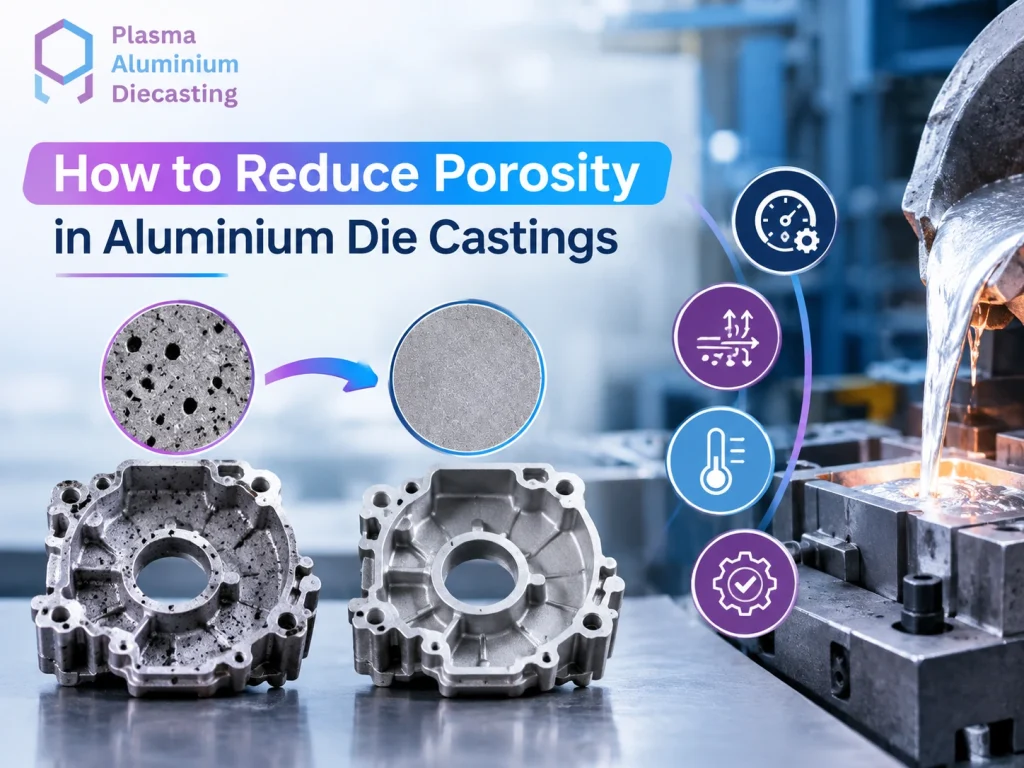
Every die caster has a story about a batch that looked perfect on the floor and failed at the customer’s end. The part was clean and the dimensions were on spec. Then machining opened up a pinhole, or a pressure test leaked. Almost every time, the culprit is porosity in aluminium die castings. It’s one of the most common and most expensive defects in the trade. The good news is that most of it can be controlled. You don’t need magic. You need a disciplined process, and you need to know where the voids come from.
This guide walks through the process fixes that actually work on the shop floor. Some of them are small tweaks. Others take a harder look at your tooling and shot control. If you run a high pressure die casting line, or you buy cast components and want to know what to ask your supplier, this should help.
What Causes Porosity in Aluminium Die Castings?
Before you fix anything, you have to know what you’re fighting. Porosity isn’t one defect. It’s a family of them, and each type has a different cause.
Gas porosity shows up as small, round, smooth-walled voids. It comes from hydrogen dissolved in the molten aluminium, or from gases produced when die lubricant burns off against the hot die surface. Aluminium is greedy for hydrogen when it’s liquid. When the metal freezes, the hydrogen can’t stay dissolved, so it escapes into tiny bubbles.
Entrapped air porosity comes from air that gets caught inside the cavity during filling. These voids are usually bigger and irregular. In HPDC, metal enters the cavity at very high speed, and if the air has nowhere to go, it gets folded into the casting.
Shrinkage porosity is different. As aluminium solidifies it contracts. If there isn’t enough liquid metal feeding the thick sections while they freeze, jagged, rough-edged voids form. You’ll often find them at hot spots, junctions, and bosses.
Many castings have more than one type at once, which is why a single fix rarely solves it. A good first step is to section a few bad parts and look at the voids. Smooth and round points toward gas. Jagged and rough points toward shrinkage. Irregular and large points toward trapped air. That ten-minute check can save you weeks of guessing.
Why Porosity Matters More Than People Think
A bit of porosity is almost unavoidable in die casting. The question is where it sits and how much of it there is.
A void in the middle of a thick, non-critical wall may never cause a problem. The same void sitting just under a machined surface is a different story. It becomes a visible pit after CNC work. On a hydraulic housing or a pump body, it becomes a leak path. On a structural bracket, it becomes a crack starter under fatigue loading.
Porosity also hurts you quietly. It lowers density, it weakens the cross-section, and it causes blistering during heat treatment or powder coating. When the gas inside a subsurface void expands in the oven, it pushes up the coating. Rejections, rework, and unhappy customers follow. So treating porosity as a quality problem alone misses the point. It’s a cost problem too.
Fix 1: Start With Cleaner, Drier Melt
Many foundries chase porosity at the die when the problem started in the furnace. If the melt carries too much hydrogen, nothing downstream will fully rescue the casting.
Here’s what helps:
- Keep the melt temperature under control. Hydrogen solubility climbs fast as the metal gets hotter. Holding the furnace higher than you need only pushes more gas in. Stay in the range your alloy and part geometry actually require.
- Dry everything that touches the melt. Moisture on ingots, returns, runners, ladles, and skimming tools is a hidden hydrogen source. Preheat charge material and tools. A cold, damp ingot dropped into molten metal is asking for trouble.
- Degas properly. Rotary degassing with dry nitrogen or argon strips dissolved hydrogen out of the melt. The impeller speed, gas flow, and treatment time all matter. A lazy five minutes with a lance won’t do the same job.
- Check the result. A reduced pressure test or density index test is a fast, cheap way to see whether degassing is working. If you aren’t measuring it, you’re guessing.
- Skim and filter. Oxide films and dross act as nucleation sites for porosity and also weaken the casting. Skim thoroughly and avoid stirring oxides back into the bath.
Treat the melt as a controlled input, the same way you’d treat alloy chemistry. Plenty of porosity problems disappear once the metal going into the shot sleeve is clean and dry.
Fix 2: Get the Shot Sleeve and Plunger Right
The shot sleeve is where air first gets into the system, and it’s often overlooked.
In cold chamber machines, the molten metal sits in the sleeve while the plunger starts its slow first-phase travel. If the sleeve is only 30 percent full, there’s a lot of air above the metal. A badly tuned plunger speed can create a wave that crashes against the end of the sleeve and traps that air before it ever reaches the die.
A few practical fixes:
- Increase the fill ratio of the shot sleeve where the part allows it. A fuller sleeve means less air to push around. Many shops aim for something in the 40 to 60 percent range, depending on the machine and part.
- Tune the slow-shot profile. The goal is a smooth wave that pushes air ahead of the metal without folding it in. Accelerate gently and avoid sudden jumps.
- Switch to the fast shot at the right moment. Changing over too early or too late either leaves air behind or causes premature filling.
- Keep the sleeve and plunger tip in good shape. Worn tips let metal blow back and create inconsistent shots. Lubricate with care, because too much plunger lubricant becomes a gas source of its own.
Small gains here add up quickly. Operators often find that a shot profile tweak reduces porosity more than any piece of new equipment would.
Fix 3: Rethink Gating and Fill Pattern
If you ask experienced die designers where porosity really gets built in, many will say gating. How the metal enters the cavity decides where air gets pushed and where it gets trapped.
Good gating does three things. It fills the cavity progressively so air is driven toward the vents and overflows. It keeps the metal front from splitting and colliding too early. And it keeps ingate velocity in a sensible window, because excessively high speed atomises the metal and mixes in air, while very low speed lets the front freeze before the cavity is full.
Common problems include ingates that point straight at a core, runners that change section abruptly, and ingates positioned so two metal fronts meet in the middle of the part with trapped air between them.
This is exactly why in-house tooling is such an advantage. When the same team that designs the die also sees the castings come off it, they can adjust the gate geometry, runner shape, and overflow placement quickly. A die that takes six weeks of outsourced rework to modify is a die that keeps making porous parts. Fill simulation software also helps, because you can see where air will trap before you cut steel.
Fix 4: Vent the Die and Use Vacuum Assist
Air has to leave the cavity before the metal arrives. Anything that blocks that exit ends up inside your casting.
Venting sounds basic, yet it’s often the weakest link. Vents get blocked by flash and lubricant residue, and sometimes they were never deep or wide enough to begin with. Check them regularly. Clean them at every scheduled maintenance, and add overflow wells at the last-to-fill areas so the cold, air-laden front of the metal has somewhere to go that isn’t your part.
Vacuum assist is the next level. A vacuum system pulls air out of the cavity and shot sleeve just before and during the shot. In high pressure die casting, it’s one of the most effective single changes for cutting gas and air porosity, especially on pressure-tight parts. It does take care to run well. The vacuum valve, seals, and vent blocks all need to be maintained, because a leak makes the system far less effective than it looks on paper.
Vacuum isn’t a cure-all. It won’t repair a dirty melt or a bad gating layout. But paired with good fundamentals, it can lift casting density noticeably.
Fix 5: Manage Die Temperature and Spray Practice
A die that’s too cold causes cold shuts and poor fill. A die that’s too hot extends solidification, which can worsen shrinkage and sticking. What you want is a stable, uniform thermal profile.
Some points that make a real difference:
- Balance the cooling circuits. Hot spots in the die lead directly to shrinkage porosity in the casting. Add or reroute cooling channels near thick sections, and use spot cooling or high-conductivity inserts where needed.
- Watch the spray. Too much release agent leaves a film of liquid on the die face. When hot metal hits it, the lubricant flashes to gas and ends up inside the part. Spray only what you need, and make sure the die surface is dry before the shot.
- Use the right lubricant. Low-gas, water-based release agents sold for die casting generate less gas. Don’t dilute them casually.
- Stabilise the warm-up. The first shots after a cold start tend to be the worst. Preheat the die properly and don’t start production until the temperature is stable.
Thermal consistency is boring work, but it’s a big part of repeatable quality.
Fix 6: Use Intensification Pressure Wisely
Shrinkage porosity is a feeding problem. As the casting solidifies, you need pressure on the metal so more liquid can flow in and fill the gap that contraction creates.
That’s the job of the intensification (or third-phase) stage. If it’s applied too late, the gate may already have frozen, and the pressure never reaches the thick section. If the pressure is too low, feeding is weak. If the gate is too thin, it freezes before it can help.
Review your timing, pressure, and gate thickness together. Some foundries add squeeze pins at thick bosses to push local pressure into a hot spot as it freezes. This is a very targeted fix and works well on parts with heavy sections that can’t be redesigned.
Fix 7: Look at Alloy and Part Design
Sometimes the process is fine and the design is the real issue.
Large wall thickness variation is a classic shrinkage trap. A thin web joining two heavy bosses will freeze first and cut off the feed to the thick regions. Designers can often even out the sections, add generous radii, or core out heavy areas without hurting function. A conversation between the design team and the caster early in development is worth far more than a fix after the first trial shots.
Alloy choice matters too. Commonly used die casting alloys such as ADC12 and A380 have good fluidity and casting behaviour, but each has its own solidification pattern. Make sure the alloy suits the geometry and the end-use, especially for pressure-tight or heat-treated parts.
When the Process Itself Is the Limit
Here’s an uncomfortable truth. High pressure die casting is brilliant for speed, thin walls, and volume. But the very thing that makes it fast, the violent high-speed fill, is also what makes air entrapment a constant risk. For some parts, you can optimise the process only so far.
If your application needs very tight porosity limits, such as pressure-tight valve bodies, structural brackets, or fatigue-critical parts, it may be time to consider a different method.
- Gravity die casting fills the mould with far less turbulence, so castings tend to be denser and lower in porosity. It suits medium volumes where mechanical properties matter more than thin-wall capability.
- Low pressure die casting fills from below under controlled pressure, with directional solidification that keeps feeding the casting as it freezes. It’s often the choice for safety-critical structural parts like wheel hubs and suspension components.
Choosing the right process at the start is cheaper than fighting porosity for months on the wrong one. A good manufacturer will tell you honestly when HPDC isn’t the best fit for your part.
Build Porosity Checks Into Your Quality Routine
Fixes only stick when you can verify them. A sensible inspection plan usually includes:
- Density index or reduced pressure tests on the melt, to catch gas problems before casting.
- Visual and dimensional checks on every shift.
- Sectioning of sample parts on a schedule, so you see what’s inside.
- X-ray (radiography) or CT scanning for critical components, to map internal voids without destroying the part.
- Leak or pressure testing for any component that must hold fluid or gas.
- Process data logging. Record shot profiles, die temperatures, and vacuum levels. When a defect appears, you can trace it back to what changed.
The most useful habit is simple. When porosity shows up, change one variable at a time and write down what happened. It’s slower than guessing, but it’s the only way to learn what really moves the needle.
Conclusion: Controlling Porosity in Aluminium Die Castings Takes the Whole Chain
Porosity in aluminium die castings rarely comes from one single mistake. It builds up across the melt, the shot sleeve, the gating, the venting, the thermal control, and the design itself. The foundries that get it under control are the ones that treat each step as part of one connected system and keep measuring the results.
This is where the choice of partner matters. As a trusted aluminium die casting manufacturer in Pune, Plasma Aluminium Diecasting brings HPDC, GDC, and LPDC together with CNC machining, powder coating, and in-house tooling under one roof. That means fewer handoffs, faster die corrections, and one team accountable for the quality of the finished component. With over 35 years of manufacturing experience, the team, led by founder Prasanna Kumar Tiwari, understands both the process detail and the delivery pressure that Pune’s Chakan and Moshi industries run on.
If porosity is costing you scrap, rework, or customer complaints, talk to the team about your component. Share your drawing, volumes, and quality requirements, and they’ll recommend the right process and alloy and help you fix the problem at the source.
[Add here: Dr. / lead engineer qualification and specialization] – The website doesn’t list a “Dr.” or any academic qualification for the founder or technical team, so I haven’t invented one. Please send me the correct name, degree, and specialization (for example, “Dr. [Name], PhD in Metallurgy, specialist in aluminium casting alloys and defect analysis”) and I’ll add it as a one-line credibility statement in this paragraph.
Frequently Asked Questions
1. What is the most common cause of porosity in aluminium die castings?
There’s no single cause, but dissolved hydrogen in the melt and trapped air during filling are the two most common. Poor venting and excess die lubricant add to the problem. Sectioning a defective part and studying the shape of the voids tells you which one you’re dealing with.
2. Can porosity be completely eliminated in die casting?
Not realistically. A small amount of porosity is natural in the process. The goal is to reduce it, keep it away from critical or machined areas, and stay within the limits your application allows.
3. Does vacuum die casting reduce porosity?
Yes. Vacuum assist removes air from the cavity before and during the shot, which cuts air and gas porosity noticeably, especially in pressure-tight components. It works best alongside good melt quality and proper venting.
4. How does degassing help reduce porosity?
Degassing removes dissolved hydrogen from the molten aluminium using an inert gas such as nitrogen or argon. Less hydrogen in the melt means fewer gas bubbles forming as the metal solidifies.
5. Which die casting method gives the lowest porosity?
Low pressure and gravity die casting generally produce denser, lower-porosity parts than HPDC because of their calmer fill. HPDC is better when you need high volumes and thin walls, and it can still deliver good quality with proper process control.
6. How is porosity detected in finished castings?
Common methods include visual checks after machining, sectioning samples, density testing, leak or pressure testing, and X-ray or CT scanning for critical parts.
7. Is porosity always a reason to reject a casting?
No. It depends on size, location, and the part’s function. A void in a non-critical thick wall may be acceptable. The same void near a sealing surface or a load path usually isn’t.

Prasanna Kumar Tiwari
Plasma Aluminium Diecasting was established after analyzing the worldwide surge in manufacturing demand across diverse sectors — from automobiles to FMCG, Oil & Gas, and Pharma. To meet this growing need, we provide a comprehensive range of precision-engineered products and industrial solutions that streamline production and enhance efficiency. As a Leading Aluminium Die Casting Manufacturer in Pune, our commitment lies in delivering innovative, technology-driven, and cost-effective solutions tailored for modern industries.