Table of contents
- What Is Mould in Casting and Why Does It Matter?
- How Does a Casting Mould Work?
- What Are the Main Types of Moulds Used in Casting?
- What Is the Step-by-Step Mould Casting Process?
- Which Materials Are Used to Make Casting Moulds?
- How Do You Choose the Right Mould for Your Part?
- Where Are Cast Parts Used? Key Industrial Applications
- What Are Common Mould Defects and How Are They Prevented?
- Conclusion: What Is Mould in Casting and Why the Right Partner Matters
- Frequently Asked Questions
- How long does it take to make a casting mould?
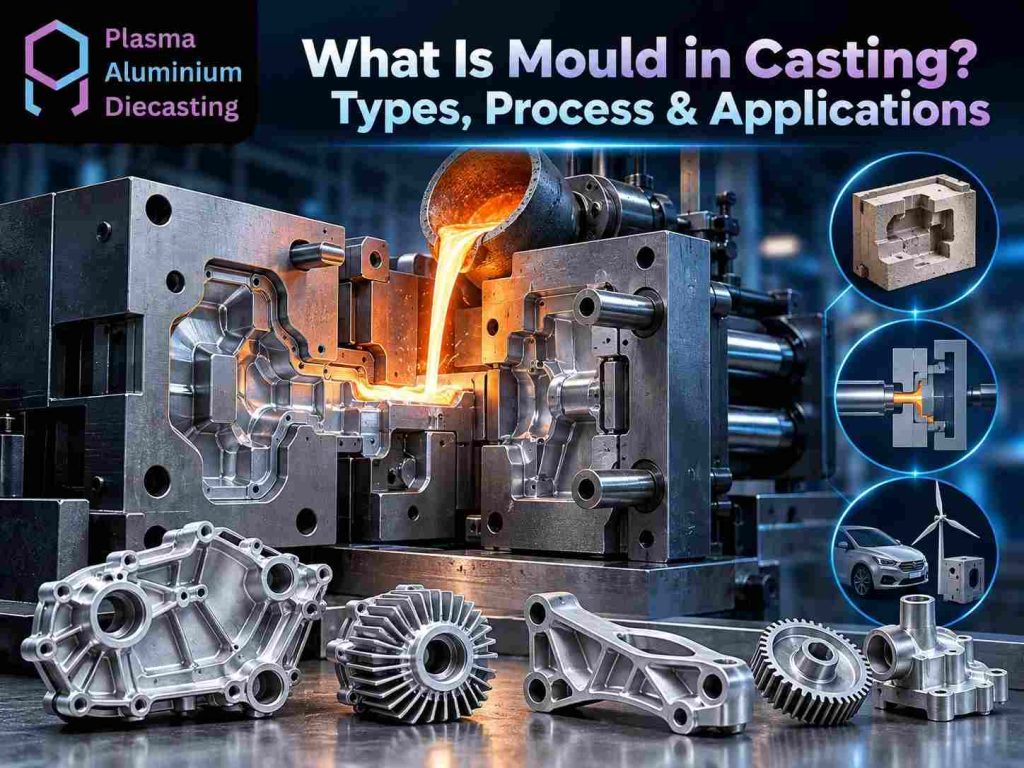
Every cast metal part starts as an empty space. Before molten aluminium, iron or brass can become a gearbox housing or a pump body, someone has to build a shape that holds that liquid metal and lets it cool into the right form. So, what is mould in casting? A mould is the hollow cavity, made from sand, ceramic or hardened steel, that gives molten metal its final shape as it solidifies. Get the mould right and the part comes out clean, accurate and strong. Get it wrong and no amount of machining will fully save it.
This guide walks through how moulds work, the main types used on foundry floors today, the step-by-step process and the industries that depend on them. If you buy, design or specify cast components, it should help you ask better questions of your supplier.
What Is Mould in Casting and Why Does It Matter?
In simple terms, a casting mould is a negative of the part you want. That is the shortest answer to what is mould in casting. Wherever the finished component has metal, the mould has empty space. Molten metal is poured or injected into that space, it cools, and the mould is either broken away or opened up to release the part.
That sounds basic, but the mould controls almost everything about the final casting:
- Dimensional accuracy: how close the part comes to the drawing
- Surface finish: whether it needs heavy machining or very little
- Internal soundness: how much porosity or shrinkage ends up trapped inside
- Production speed: how many parts you can make per hour
- Unit cost: especially once volumes climb into the thousands
This is why experienced engineers spend so much time on mould design before a single kilogram of metal is melted. The mould is where quality is decided.
How Does a Casting Mould Work?
A mould is more than a hole in the shape of a part. It is a small system, and each piece has a job.
- Cavity: the main hollow that forms the outer shape of the casting
- Core: a separate insert placed inside the cavity to create holes, channels or hollow sections
- Parting line: the joint where the two halves of the mould meet
- Sprue: the vertical channel where metal first enters
- Runners and gates: passages that carry metal from the sprue into the cavity
- Risers: reservoirs of extra metal that feed the casting as it shrinks during cooling
- Vents: small openings that let air and gases escape
Think of the gating system as plumbing. If metal flows in too fast, it becomes turbulent and traps air. Too slow, and it starts freezing before the cavity is full. A good mould designer balances these against each other, and the balance shifts with every alloy and wall thickness.
What Are the Main Types of Moulds Used in Casting?
When people ask what is mould in casting, they are often really asking which kind to use. Casting moulds fall into two broad families. Expendable moulds are destroyed to remove the part. Permanent moulds are reused hundreds or thousands of times.
Expendable Moulds
Sand moulds are the oldest and still among the most widely used. Silica sand is mixed with a binder such as clay or resin, packed around a pattern and then split open so the pattern can be removed. Sand moulds handle very large parts and almost any alloy. The trade-off is a rougher surface and looser tolerances.
Shell moulds use a thin layer of resin-coated sand that is cured against a heated metal pattern. The result is a smoother finish and better accuracy than green sand, which suits small to medium parts in moderate volumes.
Investment moulds are built by dipping a wax pattern into ceramic slurry several times. Once the ceramic hardens, the wax is melted out, leaving a precise cavity. This is the old “lost wax” method, and it produces very fine detail. It is slower and costlier per part, so it is usually kept for complex or high-value components.
Plaster moulds work in a similar way but use gypsum. They give a smooth surface and are mostly used for low-melting alloys like aluminium and zinc in prototype or short-run work.
Permanent Moulds
Permanent moulds are machined from tool steel or cast iron. They cost more upfront but pay for themselves over long runs.
Gravity die moulds are filled by simply pouring molten metal in and letting gravity do the work. Because the fill is calm, the castings tend to be dense with low porosity. If you want to see how this works in production, our page on gravity die casting services covers the process in more detail.
Low pressure die moulds sit above a sealed furnace. Gentle air pressure pushes metal upward into the cavity, which gives very controlled filling. This is a common choice for wheels and structural parts where internal soundness matters a lot. It also suits parts that will be heat treated later, since there is less trapped gas to cause blistering.
High pressure dies are the workhorses of mass production. Molten metal is forced into a hardened steel die at very high pressure and speed, so thin walls and complex shapes fill in a fraction of a second. Cycle times are short and finishes are good. Most automotive housings, brackets and electronic enclosures are made this way. Take a look at our high pressure die casting capability if your part needs thin walls at volume.
What Is the Step-by-Step Mould Casting Process?
The details change from method to method, but the overall flow is surprisingly consistent.
- Part design review: Engineers check the drawing for draft angles, wall thickness, fillets and features that may trap gas or cause shrinkage.
- Pattern or die making: For sand and investment casting, a pattern is produced. For die casting, a steel die is machined, often with cooling channels built in. This is where tooling and mould development has the biggest effect on part quality.
- Mould preparation: Sand is packed, ceramic shells are built up, or steel dies are cleaned, preheated and sprayed with release agent.
- Core placement: If the part has internal passages, cores are set into the cavity.
- Melting: The alloy is melted, degassed and brought to the right pouring temperature.
- Pouring or injection: Metal enters the mould by gravity, low pressure or high pressure depending on the method.
- Solidification: The metal cools and shrinks. Risers and cooling channels help control where and how it freezes.
- Shakeout or ejection: Expendable moulds are broken away. Permanent dies open and ejector pins push the part out.
- Fettling and finishing: Gates, runners and flash are trimmed off. Many parts then go for CNC machining and finishing to hit tight tolerances, followed by surface treatment.
- Inspection: Dimensional checks, visual inspection and sometimes X-ray or pressure testing confirm the part is sound.
Steps two and three are where most experienced foundries spend their energy. A well-built die or pattern saves hours of rework later in the line.
Which Materials Are Used to Make Casting Moulds?
The mould material has to survive contact with molten metal without cracking, melting or reacting with the alloy. Common choices include:
- Silica sand: cheap, widely available and works with most metals
- Zircon and chromite sand: better heat resistance for steel and heavy sections
- Ceramic slurries: used in investment casting for fine detail
- Gypsum plaster: suited to low-melting alloys and smooth surfaces
- Graphite: used for some non-ferrous and specialty work
- Hot work tool steel (such as H13): the standard for die casting dies because it handles repeated heating and cooling
For aluminium die casting specifically, H13 steel is the usual pick. It resists thermal fatigue, which is the fine network of cracks that forms on a die after thousands of hot and cold cycles.
How Do You Choose the Right Mould for Your Part?
There is no single correct answer. The right mould depends on what you are making and how many you need. Here is how most buyers and engineers weigh the options:
- Production volume: Sand moulds suit one-offs and small batches. Permanent dies make sense once you are into thousands of parts.
- Part size: Very large castings usually go to sand. Small to medium parts fit die casting well.
- Wall thickness: Thin walls (around 2 mm or less) generally need high pressure die casting to fill properly.
- Surface finish: Die cast and investment cast parts come out smoother than sand cast ones.
- Internal soundness: Gravity and low pressure methods tend to give lower porosity, which matters for heat-treated or pressure-tight parts.
- Budget and lead time: Steel dies take weeks to build and carry real tooling cost, while sand patterns are faster and cheaper to start.
A useful habit is to talk to your casting supplier at the design stage, not after the drawing is frozen. Small changes, like adding draft or evening out wall thickness, can make a part far easier to cast.
Where Are Cast Parts Used? Key Industrial Applications
Once you know what is mould in casting, it becomes easy to spot cast parts almost everywhere. A few of the biggest users:
- Automotive and EV: engine blocks, gearbox housings, motor housings, brackets and battery enclosures
- Aerospace and defence: lightweight structural brackets and housings where weight and strength both count
- Electrical and electronics: heat sinks, motor end covers and enclosures for switchgear and lighting
- Industrial machinery: pump bodies, valve housings, compressor parts and gear covers
- Oil and gas: valve bodies and fittings that must hold pressure
- Consumer and FMCG equipment: appliance parts, machine frames and decorative hardware
Aluminium has become especially popular in automotive and EV work because it cuts weight without giving up much strength. That shift is one reason demand for aluminium high pressure diecasting keeps growing.
What Are Common Mould Defects and How Are They Prevented?
Even good moulds can produce bad parts if the process drifts. These are the defects foundry teams watch for most closely:
- Gas porosity: small round holes caused by trapped air or hydrogen. Better venting, degassing and controlled fill speed help.
- Shrinkage cavities: irregular voids where metal pulled away as it cooled. Proper riser placement and even wall thickness reduce them.
- Cold shuts: visible lines where two streams of metal met but did not fuse. Higher metal temperature or faster filling usually fixes this.
- Misruns: the cavity did not fill fully. Often a sign of thin sections or metal that was too cool.
- Flash: thin fins of metal at the parting line, usually from worn dies or poor clamping.
- Hot tears: cracks that form while the metal is still weak. Generous fillets and good mould design help prevent them.
Most of these defects trace back to the mould itself, which brings us back to what is mould in casting at its core: a tool that decides quality before the metal is even poured. That is why simulation software, careful gating design and regular die maintenance matter so much in modern casting shops.
Conclusion: What Is Mould in Casting and Why the Right Partner Matters
So, what is mould in casting? It is the cavity that turns liquid metal into a finished part, and it shapes accuracy, strength, finish and cost more than any other single factor. Sand, shell, investment, plaster and permanent steel dies each have their place. The right choice depends on your volumes, part geometry and quality targets.
Plasma Aluminium Die Casting has been building moulds and casting aluminium parts for more than 35 years. The company was founded by Prasanna Kumar Tiwari, who brings over three decades of hands-on manufacturing experience to every project. Under his leadership, the team specialises in high pressure, gravity and low pressure die casting, with in-house tooling so the mould and the casting process are designed together rather than handed between vendors.
Here is what that means for buyers:
- In-house tooling: moulds and dies are designed and built under one roof, with standard tool lead times of around 4 to 8 weeks
- Three casting methods: HPDC, gravity and low pressure die casting, so the process can be matched to the part instead of the other way round
- Machining and finishing: CNC machining and powder coating services for ready-to-fit components
- Multi-industry experience: automotive and EV, aerospace and defence, electrical, industrial machinery, pharma and oil and gas
- Design support: practical input on draft, wall thickness and gating before tooling is cut
If you have a drawing ready or are still deciding on the right casting route, the team can review it and suggest the method and mould that make the most sense for your volumes. Reach out through the die casting manufacturer page to start the conversation.
Frequently Asked Questions
What is the difference between a mould and a die in casting?
A mould is the general term for any cavity that shapes molten metal. A die is a specific kind of permanent mould, usually machined from steel, used in die casting. All dies are moulds, but not all moulds are dies.
What is a mould made of in metal casting?
It depends on the method. Sand casting uses silica or specialty sands with binders. Investment casting uses ceramic shells. Die casting uses hardened tool steel such as H13 that can survive thousands of heating and cooling cycles.
How long does a die casting mould last?
Die life varies with alloy, part design and maintenance. Aluminium die casting dies typically run for tens of thousands to over one lakh shots before major refurbishment (industry estimate). Regular polishing, stress relieving and cooling checks extend that life.
Which type of mould is used for aluminium casting?
Aluminium can be cast in sand, plaster, investment and permanent steel moulds. For medium to high volumes, high pressure, gravity and low pressure die casting dies are the most common choices.
Why is a core used in a casting mould?
A core creates internal features that the main mould cavity cannot form on its own, such as holes, oil passages or hollow sections. Cores are placed inside the mould before metal is poured.
How long does it take to make a casting mould?
A simple sand pattern can be ready in a few days. A steel die casting die usually takes several weeks because it needs design, machining, heat treatment and trial runs before production approval.

Prasanna Kumar Tiwari
Plasma Aluminium Diecasting was established after analyzing the worldwide surge in manufacturing demand across diverse sectors — from automobiles to FMCG, Oil & Gas, and Pharma. To meet this growing need, we provide a comprehensive range of precision-engineered products and industrial solutions that streamline production and enhance efficiency. As a Leading Aluminium Die Casting Manufacturer in Pune, our commitment lies in delivering innovative, technology-driven, and cost-effective solutions tailored for modern industries.