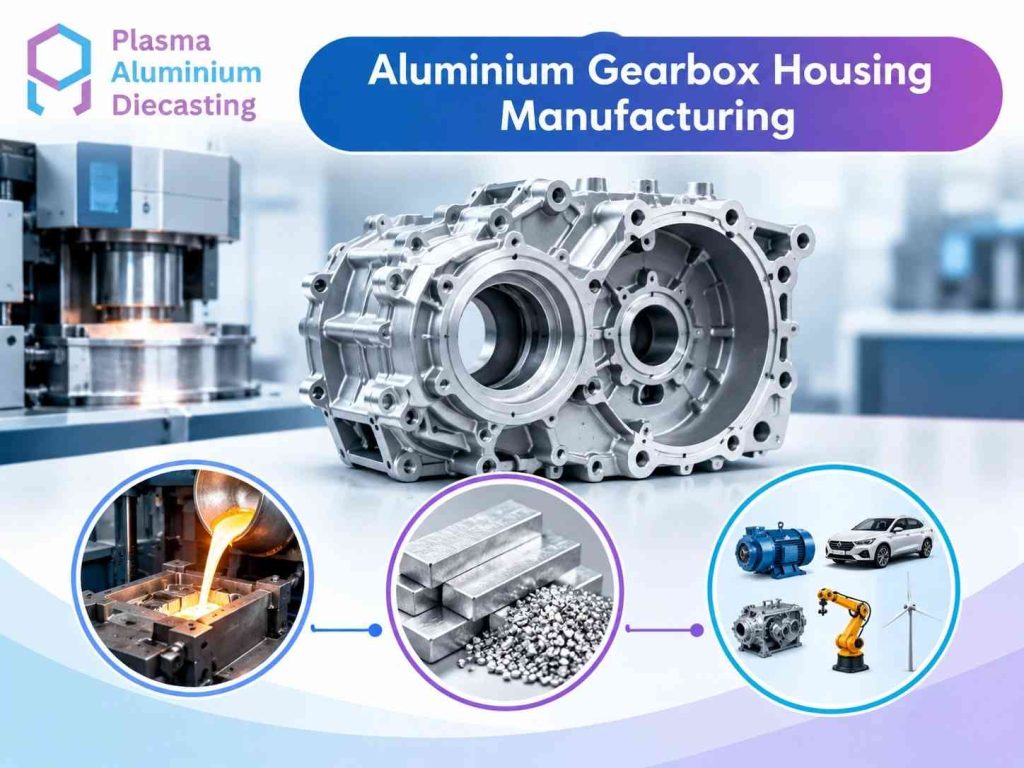
Every gearbox you have heard humming on a factory floor or inside a vehicle sits in a shell that most people never think about. That shell holds the gears, bearings and oil in exact alignment, year after year. Choosing the right aluminium gearbox housing manufacturer decides whether that shell stays quiet and sealed or starts leaking and rattling within a season.
This guide explains how an aluminium gearbox housing manufacturer turns raw ingot into a finished, tested housing, which alloys suit the job, where defects creep in and what to ask before you place an order. It is written for buyers, design engineers and procurement teams who want straight answers instead of brochure language.
What Does a Gearbox Housing Actually Do?
A gearbox housing is the structural body of the gearbox. It locates the shafts and bearings, carries the loads passing through them, keeps lubricating oil in, keeps dirt out and moves heat away from the gears. If the bearing bores sit even slightly off line, the gears mesh unevenly. Noise rises, wear speeds up and the unit gives up early.
So the housing is never just a box. It is a precision part with tight tolerances on bore position, mounting faces and sealing surfaces. A good one looks plain from the outside and works hard on the inside.
Key takeaway: A gearbox housing holds alignment, seals lubricant and sheds heat. Every manufacturing choice should protect those three jobs.
Why Is Aluminium Preferred Over Cast Iron and Steel?
Cast iron ruled gearbox housings for decades. Aluminium has taken a large share because the trade-offs now favour it, especially where weight and heat matter.
- Weight: Aluminium has roughly one third the density of steel. A lighter housing reduces vehicle weight, eases handling on the assembly line and lowers the load on mounting frames.
- Heat dissipation: Aluminium conducts heat far better than iron, so the oil runs cooler under sustained load.
- Corrosion resistance: A natural oxide layer protects the metal and a coating adds more cover.
- Design freedom: Molten aluminium fills thin walls, ribs and oil channels that would cost a lot to machine from solid metal.
- Machinability: Bores and faces cut quickly, which keeps secondary operations short.
- Recyclability: Scrap and returned parts can be remelted and reused.
Aluminium has limits too. It is less stiff than iron and weaker in thin sections under repeated stress, so designers add ribs and thicker bosses around bearing seats. Cast iron still wins in some very heavy industrial gearboxes. For most automotive, agricultural and light to medium industrial units, aluminium makes better sense, and that is why most buyers now start their search with an aluminium gearbox housing manufacturer instead of an iron foundry.
Which Aluminium Alloys Suit Gearbox Housings?
Pure aluminium is too soft for structural work. Manufacturers use silicon-rich alloys that flow well into the die and shrink very little as they set. Four grades come up again and again.
- ADC12: An aluminium-silicon-copper alloy widely used in high pressure die casting. It fills complex dies easily and gives good strength for its weight.
- A380: A close relative with similar chemistry, popular for housings that need a balance of strength, pressure tightness and cost.
- LM24: A die casting alloy under the British designation, valued for fluidity and stable dimensions.
- LM6: A high-silicon alloy with excellent castability and corrosion resistance, usually poured by gravity or low pressure into heavier sections.
The right pick depends on the process, wall thickness, load and working environment, and a capable aluminium gearbox housing manufacturer will recommend the grade only after reading your drawing and duty cycle. Alloy chemistry should be confirmed before every production run, because a small drift in iron or copper content changes how the casting behaves.
How Does an Aluminium Gearbox Housing Manufacturer Make a Housing?
Production follows a fixed sequence. Rushing one step usually shows up as scrap two steps later, so a careful shop treats each stage as its own checkpoint.
- Design review: Engineers check the drawing for castability. They look at uniform wall thickness, generous fillets, draft angles for easy ejection and ribs where stiffness is needed. Fixing a sharp corner on paper costs nothing. Fixing it in steel costs weeks.
- Tooling: The die is the heart of the process. Made from hardened tool steel, it carries the cavity, cooling lines, overflow wells and ejector pins. A supplier with in-house tooling and mould development can modify the die directly after trials, which shortens lead times and keeps design control in one place.
- Melting and degassing: Ingots melt in a furnace at a controlled temperature. Dissolved hydrogen and oxide films are removed before the metal reaches the machine, since both leave pores in the casting.
- Casting: The metal enters the die by one of three routes, covered in the next section.
- Trimming and cleaning: Gates, runners and flash come off. Castings are shot blasted or deburred as the drawing asks.
- Heat treatment, if specified: Some gravity and low pressure castings receive a T6 treatment for added strength. Conventional high pressure parts usually skip it because trapped gas can blister the surface.
- Machining and finishing: Bearing bores, mounting faces and threaded holes are brought to size, then the housing is coated and inspected.
Which Casting Method Suits a Gearbox Housing?
Three casting routes handle most housings. Each has a clear sweet spot.
- High pressure: In high pressure die casting molten aluminium is injected into a steel die at about 1,000 to 1,500 bar. Cycles are short and the surface is smooth, so it suits large volumes of thin-walled housings. The catch is trapped air, which can leave porosity in thick sections unless gating and vacuum assistance are done well.
- Low pressure: With low pressure die casting gas pressure of roughly 0.3 to 1.5 bar pushes metal gently upward into the die. The fill is calm, so porosity is lower and the structure is denser. That helps where oil sealing and strength both matter. Cycles run slower than high pressure.
- Gravity: In gravity die casting metal pours into a permanent mould under its own weight. Equipment is simpler, tooling costs less and the parts respond well to heat treatment. It fits medium volumes and heavier sections.
Key takeaway: Choose high pressure for volume and thin walls. Choose low pressure for density and sealing. Choose gravity for moderate runs that need heat treatment.
How Are Gearbox Housings Machined and Finished?
Castings rarely leave the die ready to use. Bearing bores need boring to tight tolerance, ideally in a single clamping so the bores stay concentric. Mounting faces get milled flat. Threads are tapped or fitted with inserts for bolts that see repeated tightening. Keeping CNC machining under the same roof as casting cuts transport damage and re-fixturing errors.
Surface treatment comes next. Powder coating gives an even, durable layer against moisture, oil and handling. Mating faces and bores are masked so the coat never interferes with fit. Some customers prefer paint or a plain shot-blasted finish, and the choice depends on where the gearbox will work.
Which Quality Checks and Defects Matter Most?
Gearbox housings fail in predictable ways, so inspection targets those ways.
- Porosity: Tiny voids from gas or shrinkage weaken walls and let oil seep through. Process control, vacuum assistance, X-ray sampling and vacuum impregnation all help.
- Leaks: Pressure decay or helium testing catches seepage before assembly.
- Dimensional drift: CMM or gauge checks confirm bore position, flatness and hole spacing.
- Surface flaws: Cold shuts, flow lines and sink marks show up in visual and surface finish review.
- Material mismatch: Spectrometer readings confirm that the alloy matches the order.
A reliable aluminium gearbox housing manufacturer also issues first-article reports on new parts and traces every batch back to its melt, so a problem can be tracked down in minutes rather than weeks.
What Affects the Cost of a Gearbox Housing?
Price rarely hinges on the metal alone. When an aluminium gearbox housing manufacturer prepares a quote, these factors carry the most weight.
- Tooling: The die is a one-time investment spread across the order. Higher volumes bring the cost per part down.
- Part size and weight: Bigger housings need larger machines and more metal.
- Alloy and process: Low pressure and gravity cycles run slower than high pressure, which shifts the cost per piece.
- Machining content: More bores, faces and threads mean more spindle time.
- Finish and testing: Powder coating, leak testing and impregnation each add a step.
Sharing annual volume early helps the supplier pick the process that keeps total cost sensible.
Where Are Aluminium Gearbox Housings Used?
An aluminium gearbox housing manufacturer typically serves these sectors:
- Automotive: Manual and automatic transmission cases and reduction gear units for electric vehicles.
- Two-wheelers and light vehicles: Gearbox and clutch covers.
- Agriculture: Tractor and implement drives.
- Industrial equipment: Worm and helical gearboxes for conveyors, mixers and pumps.
- Robotics and automation: Compact gear drives where weight and accuracy count.
- Electrical and power tools: Motor and gear housings.
How Do You Choose an Aluminium Gearbox Housing Manufacturer?
When you shortlist an aluminium gearbox housing manufacturer, a price quote tells you little. These questions tell you far more.
- Process range: Can the shop offer high pressure, low pressure and gravity casting, so the process fits your part and not the other way round?
- Tooling: Is the die built and repaired in-house?
- Machining: Are boring, milling and tapping done on site?
- Records: Will you receive first-article reports, inspection data and batch traceability?
- Alloy control: Is chemistry checked before each run?
- Communication: Does an engineer review your drawing before quoting and flag design risks early?
A supplier who answers all six with specifics has usually done this before.
Conclusion: Why Work With Plasma Aluminium Diecasting as Your Aluminium Gearbox Housing Manufacturer
A gearbox housing earns its keep through alignment, sealing and heat control, and all three are decided long before the first part comes off the machine. The process, the alloy, the die and the inspection plan matter more than any single price line. That is why the choice of an aluminium gearbox housing manufacturer deserves real attention.
Plasma Aluminium Diecasting brings the pieces a buyer expects from an aluminium gearbox housing manufacturer together under one roof. Customers get:
- Three casting routes: High pressure, low pressure and gravity die casting, so the process matches the part.
- In-house tooling: Die development and modification handled directly, which saves time after trials.
- Alloy choice: ADC12, A380, LM6 and LM24 with chemistry confirmed before production.
- Finishing on site: CNC machining and powder coating, so parts reach you ready to assemble.
- Documented quality: First-article reports, in-process monitoring, dimensional inspection and batch traceability.
The company was founded by Prasanna Kumar Tiwari to close the gap between rising manufacturing demand and reliable local supply, and it cites more than 35 years of manufacturing experience.
If you have a housing drawing or a sample, send it across for a design review and a quote.
Frequently Asked Questions
Which casting process is used for aluminium gearbox housings?
High pressure die casting is common for large volumes of thin-walled housings. Low pressure and gravity die casting suit parts that need denser metal, better oil sealing or heat treatment. The right choice depends on volume, wall thickness and load.
Which alloy is used for gearbox housings?
ADC12 and A380 are widely used for die cast housings because they fill dies well and offer good strength for their weight. LM24 serves a similar role. LM6 is picked for heavier sections where corrosion resistance matters.
How does an aluminium gearbox housing manufacturer stop leaks?
The shop controls melt quality, die design and gating to cut porosity, then tests finished parts for leaks. Vacuum impregnation can seal any remaining micro-pores before the housing is assembled.
Can aluminium replace cast iron in a gearbox housing?
In most automotive, agricultural and light to medium industrial gearboxes, yes. Aluminium is lighter and sheds heat better. Very heavy, high-torque units may still need cast iron, so check the load case with your design engineer.
What does an aluminium gearbox housing manufacturer need to prepare a quote?
Send a 2D drawing and a 3D model, the annual volume, preferred alloy, critical tolerances, machining needs and the surface finish required. A sample part helps if one exists.

Prasanna Kumar Tiwari
Plasma Aluminium Diecasting was established after analyzing the worldwide surge in manufacturing demand across diverse sectors — from automobiles to FMCG, Oil & Gas, and Pharma. To meet this growing need, we provide a comprehensive range of precision-engineered products and industrial solutions that streamline production and enhance efficiency. As a Leading Aluminium Die Casting Manufacturer in Pune, our commitment lies in delivering innovative, technology-driven, and cost-effective solutions tailored for modern industries.