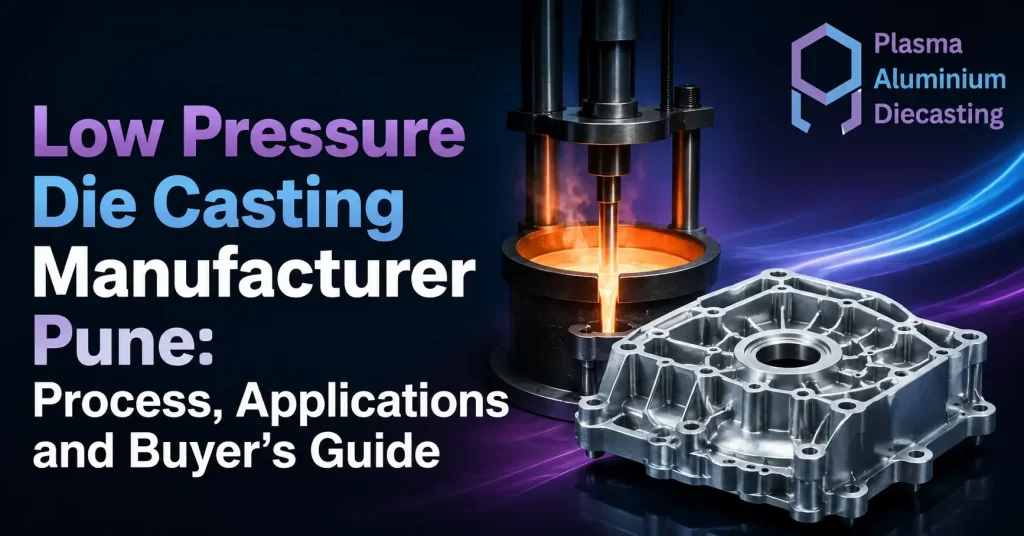
| ► LPDC fills the die cavity from below under controlled gas pressure of 0.3 to 1.5 bar, producing significantly lower porosity than HPDC in thick-section structural parts. |
| ► Typical LPDC mechanical properties: tensile strength 220 to 280 MPa, elongation 3 to 8 percent, Brinell hardness 75 to 90 HB for A356 alloy in T6 condition. |
| ► LPDC is the standard manufacturing process for aluminium road wheels, suspension knuckles, engine blocks and safety-critical structural castings globally. |
| ► Tooling cost for LPDC dies is INR 5 lakh to INR 20 lakh for medium-complexity parts — higher than HPDC because of die volume and controlled-filling hardware. |
| ► Cycle time for LPDC is 3 to 8 minutes per part, slower than HPDC but faster and more dimensional than sand casting. |
| ► LPDC achieves tolerances of +/-0.3 mm to +/-0.5 mm as-cast on most features, with CNC post-machining reaching IT7 on critical surfaces. |
| ► A356 and A357 alloys are standard for LPDC structural parts because their high silicon and magnesium content gives excellent fluidity and heat-treat response. |
Introduction: Why LPDC Exists and What Problem It Solves
High pressure die casting fills dies in milliseconds at 400 to 1,200 bar, which is optimal for thin-wall, high-volume parts. But for a thick-section structural component like an aluminium wheel or a suspension knuckle — where a single subsurface void can cause fatigue failure — that violent fill creates unacceptable porosity risk. Low pressure die casting manufacturer Pune-based suppliers use a fundamentally different filling method: controlled bottom-up fill under modest gas pressure, which produces dense, low-porosity castings with mechanical properties close to those of permanent-mould gravity casting but with better dimensional repeatability and faster cycle times.
| Parameter | Value |
| Filling pressure | 0.3 to 1.5 bar (controlled riser tube) |
| Typical alloys | A356, A357, LM25 (AlSi7Mg) |
| Tensile strength (A356-T6) | 220 to 280 MPa |
| Elongation (A356-T6) | 3 to 8 percent |
| Cycle time per part | 3 to 8 minutes depending on part weight |
| Dimensional tolerance as-cast | +/-0.3 mm to +/-0.5 mm on most features |
| Metric | Data | Source |
| India aluminium wheel LPDC production 2024 | 38 million units (est.) | SIAM / ACMA 2025 |
| Share of LPDC in global aluminium casting output | Approx. 12 percent | Industry estimate |
| LPDC alloy consumption India (A356/A357) 2024 | 42,000 metric tonnes (est.) | IBEF Metals 2024 |
| Automotive structural aluminium CAGR India 2024-2029 | 11.2 percent | Industry estimate |
| EV battery tray casting (LPDC/HPDC) India 2024-25 | Growing at 35 percent YoY | Industry estimate |
| LPDC tooling investment per programme typical range | INR 5 lakh to INR 20 lakh | Industry estimate |
| Pune auto-component structural casting output | USD 820 million (est.) | ACMA 2025 |
How Low Pressure Die Casting Works
In LPDC, a sealed crucible of molten aluminium alloy is positioned below the die. A stalk tube connects the crucible to the die cavity through the bottom. When the die is closed and ready, low-pressure inert gas (typically dry air or nitrogen) is introduced into the sealed crucible at 0.3 to 1.5 bar. This gentle overpressure pushes the molten metal up through the stalk and into the die from below, filling the cavity in a smooth, turbulence-free manner.
The controlled, bottom-up fill prevents the tumbling and air entrainment that characterises HPDC’s high-velocity injection. Metal enters the die at low velocity, displacing air upward through vents at the top of the cavity. Solidification begins at the remotest points from the gate and progresses toward the stalk, which acts as a natural feeder — replenishing liquid metal as the casting contracts. This directional solidification minimises shrinkage porosity and produces dense castings with consistent mechanical properties across the section.
LPDC vs HPDC vs GDC: Which Process for Which Part
| Criterion | LPDC | HPDC | GDC |
| Fill method | Bottom-up, controlled pressure | High-velocity injection | Gravity pour |
| Porosity level (thick sections) | Very low — best of three | Higher risk in thick sections | Low to medium |
| Minimum wall thickness | 3 mm typical | 0.8 mm | 2.5 mm |
| Dimensional tolerance | +/-0.3 to +/-0.5 mm | +/-0.1 to +/-0.3 mm | +/-0.3 to +/-0.6 mm |
| Tooling cost (single cavity) | INR 5 to 20 lakh | INR 3 to 15 lakh | INR 0.8 to 5 lakh |
| Cycle time | 3 to 8 minutes | 15 to 45 seconds | 2 to 5 minutes |
| Best applications | Wheels, structural, safety parts | Engine covers, brackets, housings | Motor end-shields, pump bodies |
| T6 heat treatment compatible | Yes — primary advantage | Limited (blistering risk) | Yes |
Materials for LPDC: Why A356 and A357 Are the Standard Choice
A356 (AlSi7Mg0.3) and A357 (AlSi7Mg0.6) are the dominant alloys for LPDC structural castings worldwide. Their high silicon content (7 percent) gives excellent fluidity for controlled low-pressure filling, while the magnesium addition provides the heat-treatment response needed to achieve T6 temper properties. T6 heat treatment — solution heat treatment at 540 degrees C, quench and artificial ageing at 155 to 165 degrees C — doubles the yield strength of A356 from approximately 100 MPa as-cast to 200 to 220 MPa in T6 condition.
LM25 (BS 1490) is the British Standard equivalent of A356 and is widely specified for export programmes. The alloy’s low iron content — typically below 0.15 percent in premium grades — is essential for structural applications because iron-rich intermetallic phases act as crack initiation sites in fatigue loading.
Applications: Where LPDC Is the Required Process
| Application | Why LPDC Is Specified | Typical Alloy |
| Aluminium road wheels (passenger car) | Low porosity for pressure tightness and fatigue life | A356-T6 |
| Suspension knuckles and uprights | Structural integrity, no porosity under fatigue load | A357-T6 |
| Engine blocks and cylinder heads (small engines) | Pressure tightness for coolant and oil channels | A356-T6 or LM25 |
| EV battery tray structures | Dimensional accuracy and lightweighting | A356-T6 |
| Brake caliper bodies (high-performance) | Hydraulic pressure tightness | A357-T6 |
| Large industrial pump housings | Leak-free performance under sustained pressure | LM25 |
LPDC Tooling: Cost, Design and Lead Time
LPDC dies operate at lower injection pressure than HPDC but require larger tool volumes to accommodate the stalk tube, bottom-fill runner and larger part geometry. H13 tool steel is standard. Single-cavity LPDC die cost for a medium-complexity part in the 3 to 8 kg range typically runs INR 8 lakh to INR 15 lakh in Pune, reflecting the greater steel volume and the precision required in the stalk-to-cavity interface.
Tooling lead time for LPDC is 6 to 10 weeks from drawing approval to first sample shots — slightly longer than equivalent HPDC tooling because of the additional stalk tube and gate design complexity. DFM review before tooling commitment is particularly valuable for LPDC because wall thickness uniformity and feeder design have a direct impact on casting soundness and T6 heat treatment response.
Post-Casting Operations for LPDC Parts
Most structural LPDC castings require T6 heat treatment before final use. Solution treatment is performed at 535 to 545 degrees C for 6 to 10 hours, followed by water quench and ageing at 155 to 165 degrees C for 4 to 6 hours. The resulting T6 condition delivers the mechanical property improvement that justifies the alloy selection and process investment.
CNC machining is standard for bearing bores, mating faces and datum features. X-ray or CT porosity inspection is specified for safety-critical parts such as wheels and knuckles per ASTM E155 or equivalent. Leak testing on pressure-retaining parts uses air or helium under defined test pressure protocols.
LPDC Services at Plasma Aluminium Diecasting, Pune
Plasma Aluminium Diecasting offers low pressure die casting as part of its integrated aluminium casting capability near Chakan MIDC in Pune. The LPDC service covers A356 and A357 alloy processing, in-house tooling development, T6 heat treatment coordination and CNC post-machining. For buyers in Pune’s automotive and industrial sectors considering structural aluminium components, Plasma’s integrated offering from die design through to finished, inspection-released component removes the need to manage multiple specialist sub-contractors across the programme.
FAQ: Low Pressure Die Casting in Pune
LPDC and HPDC use different alloy families. ADC12 and A380 are standard HPDC alloys with high silicon content optimised for fast fill. A356 and A357 are standard LPDC alloys with lower silicon and added magnesium optimised for heat treatability and structural properties. Using HPDC alloys in LPDC is technically possible but does not fully use the process capability for structural performance.
T6 is required when the application demands the highest mechanical properties from the alloy — typically for safety-critical structural parts. For non-structural housings or covers where as-cast properties are sufficient, T6 is not required and the additional process cost and time are avoided.
LPDC dies typically last 20,000 to 40,000 cycles before significant cavity wear, compared to 80,000 to 120,000 shots for HPDC. The longer cycle time and lower operating pressure of LPDC mean thermal fatigue cycles accumulate more slowly, but the larger volume of liquid metal contact per cycle accelerates erosion in the stalk zone.
Practical minimum wall thickness for LPDC is 3 mm for medium-sized parts. Aluminium fills the die more slowly under low pressure than under HPDC injection, so thinner walls risk incomplete fill (misrun) before solidification. For walls below 3 mm, HPDC is the technically correct process.
Yes. X-ray and CT porosity inspection per ASTM E155 or customer-specified acceptance criteria are available for safety-critical LPDC castings. Discuss X-ray inspection requirements at the RFQ stage so inspection costs and cycle times can be incorporated into the programme plan.
Conclusion
Low pressure die casting fills a critical gap in the aluminium casting process portfolio — delivering the low porosity and structural integrity required for safety-critical applications that HPDC cannot reliably achieve. For wheels, suspension components, EV structures and pressure-critical industrial parts, LPDC with A356-T6 alloy is the technically correct choice. A low pressure die casting manufacturer Pune-based with integrated LPDC, CNC and heat treatment capability provides programme teams with a single-source solution for these demanding applications.
Submit an RFQ or drawing for LPDC evaluation to us. Specifications and pricing vary by order volume, material grade and finish requirements. Contact the team for a detailed technical datasheet and quote

Prasanna Kumar Tiwari
Plasma Aluminium Diecasting was established after analyzing the worldwide surge in manufacturing demand across diverse sectors — from automobiles to FMCG, Oil & Gas, and Pharma. To meet this growing need, we provide a comprehensive range of precision-engineered products and industrial solutions that streamline production and enhance efficiency. As a Leading Aluminium Die Casting Manufacturer in Pune, our commitment lies in delivering innovative, technology-driven, and cost-effective solutions tailored for modern industries.