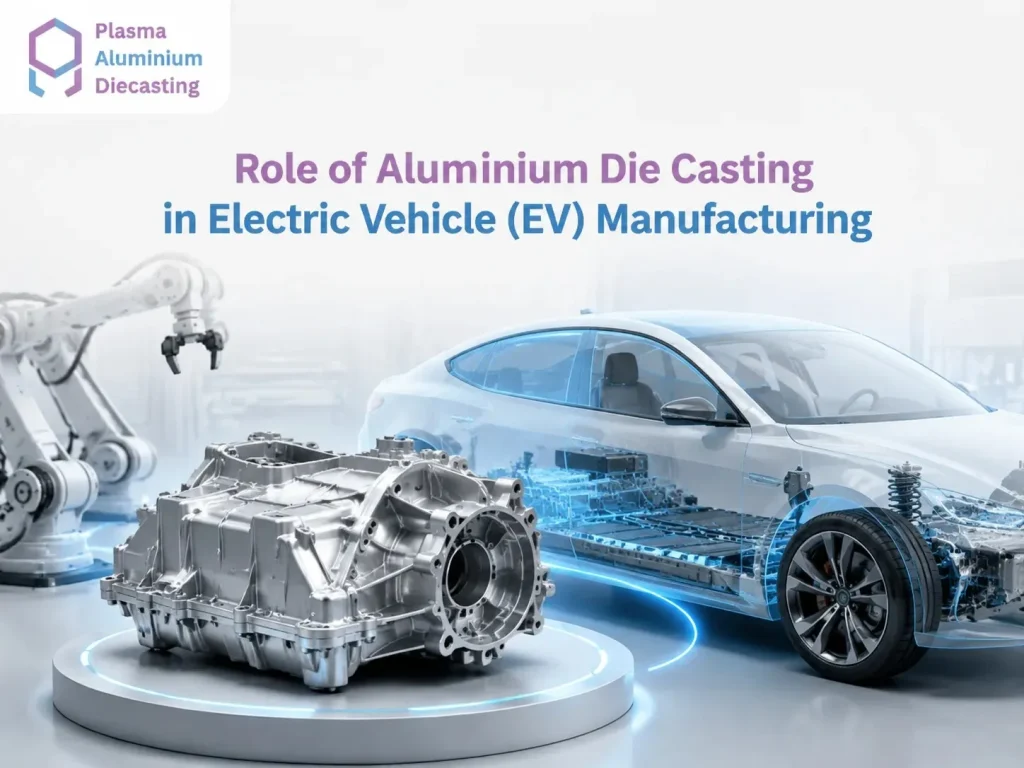
Electric vehicles are changing fast, and so is the way they get built. One shift that does not get talked about enough is the material sitting under the hood, under the seats, and around the battery pack. That material is aluminium, and the process that shapes it is called die casting.
If you have ever wondered why EV makers keep pushing for lighter cars, better range, and fewer parts on the assembly line, Aluminium Die Casting in Electric Vehicle manufacturing is a big part of that answer. This process has grown from a niche choice into a mainstream one, and this blog looks at what it actually does, why it matters for EVs specifically, and where the technology is heading.
What Is Aluminium Die Casting?
Aluminium die casting is a manufacturing process where molten aluminium is forced into a steel mould under high pressure. The metal cools and takes the exact shape of the mould cavity. Once it hardens, the part is ejected, trimmed, and machined if needed.
It sounds simple, but the precision involved is not simple at all. A single mould can produce thousands of identical parts, each one matching tight dimensional tolerances. That consistency is exactly what carmakers need when they are building thousands of vehicles a month.
High Pressure Die Casting (HPDC)
Most automotive aluminium parts, including EV components, are made using high pressure die casting. Molten metal is injected into the mould at speeds that can exceed 500 km/h. This fills even the thinnest sections of a complex part in a fraction of a second, which is why HPDC is the preferred method for aluminium die casting in electric vehicle production, especially for large, intricate parts like battery trays and motor housings.
Gravity Die Casting
Gravity die casting relies on gravity alone to fill the mould, without external pressure. It is slower than HPDC but produces parts with fewer internal defects, which makes it suitable for components that face higher structural loads, such as certain suspension parts.
Why EV Makers Are Switching to Aluminium Die Casting
Traditional cars run on internal combustion engines, and their body structures were designed around steel for decades. EVs are a different story. They carry heavy battery packs, and every extra kilogram anywhere else in the car eats into driving range. That single fact has pushed automakers toward aluminium die casting in electric vehicle platforms, since aluminium offers the best mix of low weight and reliable strength.
Steel is strong, but it is also heavy. Aluminium weighs roughly a third of steel for a similar volume, and die casting lets manufacturers shape it into complex, load bearing parts without adding unnecessary bulk. When you are trying to squeeze another 20 or 30 kilometres of range out of a battery pack, shaving weight off the chassis and body is one of the easiest wins available.
There is also a manufacturing efficiency angle. A traditional car underbody might be welded together from 60 or 70 stamped steel parts. With large aluminium die castings, that number can drop to a handful of pieces, sometimes even one single casting. Fewer parts mean fewer welds, fewer robots on the line, and fewer places where things can go wrong during assembly.
Key EV Components Made With Aluminium Die Casting
Battery Enclosures and Trays
The battery pack is the heart of an EV, and it needs a housing that protects it from road debris, moisture, and impact while also managing heat. This is one of the clearest examples of aluminium die casting in electric vehicle battery systems, since die cast trays offer a good balance of strength and weight, and aluminium’s natural ability to conduct heat helps keep the battery pack running at a stable temperature.
Motor Housings
Electric motors generate heat during operation, and the housing around them needs to dissipate that heat efficiently while protecting internal components. Die cast aluminium motor housings do this job well, and they can be designed with integrated cooling channels that would be difficult or expensive to achieve with other materials.
Structural and Chassis Components
Front and rear underbody structures, shock towers, and subframes are increasingly made through aluminium die casting. These parts carry real structural load, so the casting process has to be tightly controlled to avoid porosity or weak points.
Gigacasting: The Bigger Shift
A newer trend called gigacasting takes this idea further. Instead of casting a dozen smaller parts and welding them together, manufacturers use massive die casting machines to produce entire sections of the car underbody in one shot. This reduces assembly time drastically and cuts down on the number of welds, which also improves overall body rigidity. It is one of the clearest signs of where aluminium die casting in electric vehicle manufacturing is headed next.
If your team is exploring die casting solutions for automotive or EV components, it helps to work with a manufacturer that understands these specific demands. You can check the aluminium die casting services offered for automotive applications to see how the process is applied across different part types.
Benefits of Aluminium Die Casting in Electric Vehicle Manufacturing
Weight Reduction Without Compromising Strength
This is the most obvious benefit, but it is worth repeating because it affects almost every performance metric of an EV. Lighter vehicles need less energy to move, which directly improves range per charge. Die cast aluminium parts achieve this without sacrificing the structural strength needed for crash safety.
Better Thermal Management
Battery packs and motors both need to stay within a certain temperature range to perform well and last long. Aluminium’s thermal conductivity is far higher than steel, which means heat moves away from sensitive components faster. This is one reason aluminium is the default choice for battery enclosures and motor casings.
Design Flexibility
Die casting allows for complex geometries, thin walls, and integrated features like mounting points, ribs, and cooling channels, all cast into a single part. Designers get more freedom to optimise a component’s shape for both weight and performance, something that is much harder to do with stamped or forged parts.
Fewer Parts, Simpler Assembly
As mentioned earlier, large aluminium castings can replace dozens of smaller stamped and welded parts. This shortens assembly lines, reduces labour and equipment costs over time, and lowers the chance of assembly errors.
Recyclability
Aluminium is highly recyclable, and scrap generated during the casting process can be melted down and reused with minimal loss in quality. For automakers under pressure to lower their environmental footprint, this matters just as much as the weight savings.
Quick Fact Box Aluminium die casting can reduce component weight by up to 40 percent compared to equivalent steel parts, and gigacasting has cut underbody assembly time from hours to a couple of minutes in some production lines. That kind of efficiency is a major reason aluminium has become central to EV manufacturing.
Challenges That Come With Aluminium Die Casting in Electric Vehicle Production
It is not all smooth sailing. Aluminium Die Casting in Electric Vehicle manufacturing comes with its own set of hurdles that manufacturers have to work through.
Large castings, especially the gigacasting parts, require enormous die casting machines that cost tens of millions of dollars and take up significant floor space. That is a big capital investment, and it only makes sense for manufacturers producing at scale.
Porosity is another concern. Trapped gas or shrinkage during cooling can create tiny voids inside a casting, weakening it in ways that are not always visible from the outside. This is why quality control, including X-ray inspection and pressure testing, plays such an important role in automotive die casting.
Repairability is also a talking point in the industry. When a single large casting replaces multiple smaller parts, a minor collision that once required replacing one small panel might now mean replacing a much bigger, more expensive section. Some manufacturers are already working on modular casting designs to address this.
Aluminium Die Casting vs Other Manufacturing Methods
Compared to steel stamping, aluminium die casting offers lower weight and fewer parts, though tooling costs can be higher upfront. Compared to aluminium extrusion, die casting allows far more complex three dimensional shapes, while extrusion is better suited for long, uniform profiles like door sills or roof rails.
Forging produces stronger parts in terms of fatigue resistance, but it is limited to simpler shapes and is generally more expensive per part. For components that need intricate geometry combined with reasonable strength and cost, die casting usually comes out ahead, which is exactly why Aluminium Die Casting in Electric Vehicle manufacturing has become the go-to process for so many EV parts.
The Future: Where Aluminium Die Casting Is Headed in EV Manufacturing
The trend toward larger, more integrated castings is not slowing down. More automakers are investing in gigacasting or similar large scale casting technologies to reduce production time and cost. Alongside that, alloy development is improving too, with newer aluminium alloys designed specifically for high pressure die casting that offer better ductility, meaning parts can absorb more impact energy without cracking.
There is also growing interest in combining die casting with other lightweight materials, like using aluminium castings alongside carbon fibre reinforced panels in specific high stress zones. As battery technology improves and vehicle designs evolve, aluminium die casting is likely to expand into even more parts of the vehicle, not just the ones it already dominates.
Choosing the Right Aluminium Die Casting Partner
For automakers and EV component suppliers, picking the right manufacturing partner matters as much as the material choice itself. Look for a manufacturer with proven experience in automotive grade tolerances, in-house tooling capability, and a track record of handling high volume production without compromising on quality.
You can learn more about the manufacturing background and capabilities on the Plasma aluminium diecasting‘s official website, which outlines the experience behind the casting processes used for automotive and EV applications. If you are evaluating suppliers for an upcoming EV component project, it is worth reaching out directly to discuss part specifications and production requirements.
Conclusion
Aluminium die casting in electric vehicle manufacturing has moved from being a helpful option to a genuinely central part of how electric vehicles get built. It brings weight savings, better thermal performance, design flexibility, and simplified assembly, all of which matter directly to how far an EV can travel on a single charge and how efficiently it can be produced. Yes, there are real challenges around tooling cost, quality control, and repairability, but the industry is actively solving these as adoption grows.
As EV production scales up worldwide, expect aluminium die casting, and particularly gigacasting, to play an even bigger role in shaping how future electric vehicles are designed and manufactured.
Frequently Asked Questions
Aluminium weighs significantly less than steel while still offering enough strength for automotive use, which directly helps improve an EV’s driving range without compromising structural safety.
Gigacasting uses very large die casting machines to produce entire vehicle sections, like the front or rear underbody, in a single piece, instead of assembling many smaller stamped and welded parts.
Battery enclosures, motor housings, structural underbody sections, and various chassis components are among the most common EV parts made through aluminium die casting.
Tooling costs for aluminium die casting can be higher upfront, but the reduced part count, lighter weight, and simplified assembly often bring down overall production and material handling costs over time.
Yes, aluminium is one of the most recyclable metals used in manufacturing, and scrap from the casting process can be remelted and reused with very little loss in material quality.

Prasanna Kumar Tiwari
Plasma Aluminium Diecasting was established after analyzing the worldwide surge in manufacturing demand across diverse sectors — from automobiles to FMCG, Oil & Gas, and Pharma. To meet this growing need, we provide a comprehensive range of precision-engineered products and industrial solutions that streamline production and enhance efficiency. As a Leading Aluminium Die Casting Manufacturer in Pune, our commitment lies in delivering innovative, technology-driven, and cost-effective solutions tailored for modern industries.