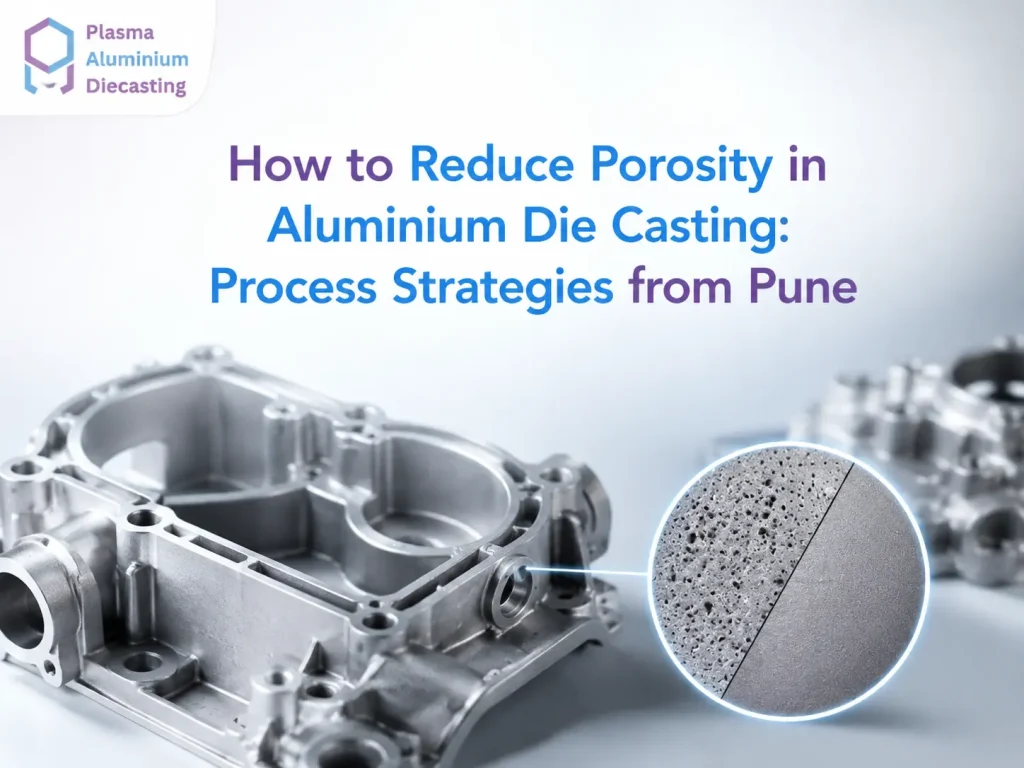
| ► Porosity in HPDC aluminium castings has two primary sources: gas porosity from trapped air or hydrogen, and shrinkage porosity from insufficient feeding during solidification. |
| ► Vacuum-assisted HPDC (vacuum die casting) reduces gas porosity by extracting air from the die cavity before injection, enabling heat-treatable aluminium alloys and structural applications. |
| ► Correct gating design — gate size, runner cross-section and overflow well placement — reduces turbulent fill velocity and minimises air entrapment at the leading metal front. |
| ► Die temperature uniformity within +/-15 degrees C across the cavity face significantly reduces shrinkage porosity in thick-section areas. |
| ► ADC12 alloy at secondary quality may contain elevated hydrogen from contaminated scrap; specifying primary ADC12 or performing degassing reduces gas porosity by 40 to 60 percent. |
| ► X-ray inspection per ASTM E505 or ASTM E155 is required for safety-critical or pressure-retaining parts to verify porosity acceptance criteria. |
| ► Porosity acceptance levels should be defined in the drawing or specification — not left to the casting supplier’s judgement — to avoid disputes at inspection. |
Introduction: Porosity Is the Die Caster’s Most Common and Costly Defect
Procurement teams sourcing aluminium die cast components for pressure-critical or structural applications consistently encounter one quality issue above all others: porosity. Voids inside the casting wall range from invisible sub-micron shrinkage to millimetre-scale gas pores that cause leaks in pressure tests, fatigue failure in structural applications or cosmetic blemishes in machined surfaces. Understanding how to reduce porosity in aluminium die casting is not solely the casting supplier’s problem — it is a shared engineering challenge that starts with part design and ends with production process control. This guide explains the root causes and the most effective solutions available to Pune manufacturers.
| Parameter | Value |
| Primary porosity types | Gas porosity (air/hydrogen) and shrinkage porosity (solidification) |
| Acceptable porosity level (non-critical) | Typically Class 2 to Class 3 per ASTM E505 |
| Pressure-critical acceptance | Class 1 per ASTM E505 or customer specification |
| Vacuum die casting cavity vacuum | 50 to 100 mbar residual pressure during fill |
| Degassing treatment effectiveness | Reduces hydrogen content by 40 to 60 percent |
| Die temperature uniformity target | +/-15 degrees C across cavity face |
| Metric | Data | Source |
| Porosity share of HPDC scrap in India | 35 to 50 percent of total defects | Industry estimate |
| Cost of scrap and rework from porosity India 2024 | USD 180 million (est.) | Industry estimate |
| Vacuum die casting adoption rate India 2024 | Approx. 15 percent of HPDC capacity | Industry estimate |
| X-ray inspection machine installations Pune belt | 30+ units in active production | CII Pune 2024 |
| Hydrogen in secondary ADC12 vs primary | 0.3 to 0.6 ml/100g vs 0.1 to 0.2 ml/100g | Industry estimate |
| Porosity reduction from optimised gating design | 20 to 40 percent defect reduction | Industry estimate |
| India HPDC first-pass quality target (automotive) | 98 percent or above | ACMA quality benchmark |
Understanding the Two Types of Porosity in HPDC
Gas porosity forms when air or dissolved hydrogen is trapped in the metal during the high-velocity fill phase of HPDC. The metal front breaks up into droplets and ligaments as it travels through the gate at 30 to 50 m/s, entraining air from the die cavity that has not been fully expelled through the vents. This entrapped air cannot escape once the metal solidifies and remains as rounded voids distributed through the casting.
Shrinkage porosity is a solidification phenomenon. As aluminium cools from liquid to solid, it contracts by approximately 6 to 7 percent by volume. Where thick sections cool more slowly than the surrounding metal, the supply of liquid metal to compensate for this contraction is cut off before solidification completes, leaving an irregular void in the last-to-freeze zone. Shrinkage porosity is characterised by irregular, branching morphology — visibly different from the rounded bubbles of gas porosity.
Solution 1: Optimised Gating and Venting Design
| Gating Parameter | Poor Practice | Best Practice | Effect on Porosity |
| Gate velocity | Above 60 m/s (typical default) | 35 to 55 m/s controlled | Reduces air entrainment by 30 to 50 percent |
| Gate cross-section | Undersized — one gate for complex part | Multiple gates distributing fill evenly | Eliminates isolated air pockets |
| Overflow wells | Absent or undersized | Positioned at last-fill zones | Captures leading cold/oxidised metal |
| Vent area | Less than 0.3 cm2 per 100 cm3 cavity | 0.5 to 1.0 cm2 per 100 cm3 cavity | Allows air to escape before metal arrives |
| Runner cross-section | Constant area — no acceleration control | Tapered to maintain progressive fill | Reduces turbulence in runner system |
Solution 2: Vacuum-Assisted Die Casting
Vacuum die casting evacuates the die cavity and shot sleeve to 50 to 100 mbar before the injection plunger moves. This removes 95 to 98 percent of the air that would otherwise be entrapped during fill. The result is a dramatically denser casting with lower gas porosity that can be heat-treated — something that conventional HPDC cannot achieve because residual porosity blisters during the solution heat treatment cycle.
Vacuum HPDC is more expensive than standard HPDC — the vacuum hardware and valve maintenance add 8 to 15 percent to per-part cost — but for structural applications where T6 heat treatment is needed or where pressure tightness is mandatory, the process pays back its cost premium immediately in reduced scrap and leak test failure rates.
Solution 3: Alloy Quality and Hydrogen Degassing
Hydrogen dissolves readily in liquid aluminium at temperatures above 600 degrees C, particularly when the melt is exposed to moisture in the charge material or holding furnace atmosphere. Secondary ADC12 produced from unverified scrap can contain 0.3 to 0.6 ml of hydrogen per 100 grams of metal — above the threshold where gas porosity becomes a significant production issue. Primary ADC12 from certified ingot suppliers typically measures 0.1 to 0.2 ml/100g.
Rotary degassing with nitrogen or argon purge gas is the standard treatment for removing dissolved hydrogen from the holding furnace before casting. A 10 to 15-minute rotary degassing cycle reduces hydrogen to below 0.15 ml/100g in most production situations. Specifying degassed primary alloy in your purchase order — rather than accepting any secondary material — reduces gas porosity by 40 to 60 percent without any process change to the casting operation itself (Industry estimate).
Solution 4: Die Temperature Management
Die temperature variation across the cavity face is a leading cause of shrinkage porosity in thick-section areas. When one zone of the cavity face runs 30 degrees C cooler than an adjacent zone, the solidification front advances unevenly. Sections that solidify early cut off liquid metal supply to sections still liquid, creating isolated shrinkage voids.
Water-cooled inserts in thick-section zones and additional heating in thin-section zones are the standard tools for die temperature uniformity control. Thermal imaging cameras mounted over the open die — available in modern HPDC production lines — give real-time feedback on die temperature distribution. Maintaining die temperature within +/-15 degrees C across the cavity face reduces shrinkage porosity in thick sections significantly (Industry estimate).
Solution 5: Intensification Pressure in HPDC
Intensification pressure is the final stage of the HPDC shot cycle, applied after the cavity is filled but before the metal fully solidifies. The plunger continues forward, compressing the semi-solid metal in the cavity at pressures of 800 to 1,500 bar. This intensification crushes gas bubbles and forces liquid metal into micro-shrinkage zones, producing a denser casting than non-intensified shots.
Intensification effectiveness depends on timing — the pressure must be applied while the casting is still partially liquid in the critical thick sections. This requires careful process window definition and consistent machine response. Well-calibrated intensification reduces combined porosity levels by 15 to 30 percent in thick-section HPDC parts (Industry estimate).
Inspection and Acceptance: How to Define Porosity Limits in Your Specification
The most common source of disputes between casting buyers and suppliers is undefined or ambiguous porosity acceptance criteria. A drawing that states ‘no porosity’ is unachievable in HPDC and unfair to the supplier. A drawing that specifies nothing about porosity leaves the buyer exposed to receiving parts that fail pressure tests or structural performance requirements.
ASTM E505 provides a standard visual comparison atlas for High Pressure Die Casting, with porosity severity classes from 1 (best) to 6. ASTM E155 provides equivalent references for radiographic inspection. Specifying acceptance criteria by reference to these standards — for example, ‘Class 2 maximum per ASTM E505 on section X, Class 3 maximum elsewhere’ — gives both buyer and supplier a clear, testable requirement.
FAQ: Reducing Porosity in Aluminium Die Casting
Q: Can heat-treated (T6) HPDC parts be produced without vacuum die casting?
Standard HPDC parts blister during solution heat treatment because residual gas porosity expands under the 540 degrees C treatment temperature. Vacuum-assisted HPDC reduces residual porosity to levels that do not cause blistering, enabling T6 treatment. Without vacuum, T5 temper (artificial ageing without solution treatment) is the maximum heat treatment achievable on HPDC parts.
Q: How do I specify X-ray inspection for die cast parts?
Reference ASTM E505 (visual) or ASTM E155 (radiographic) in the drawing notes, specifying the maximum acceptable class for each critical section. Include the location of critical sections on the drawing using section cut identifiers. State whether 100 percent inspection or AQL sampling inspection is required for production runs.
Q: Does porosity always cause leaks?
No. Porosity causes leaks only when individual voids interconnect to form a channel from one surface to the other. Isolated porosity — voids not connected to the surface or to each other — does not cause pressure leaks but may affect fatigue life in structural applications. X-ray inspection can detect isolated internal porosity; pressure testing is the only way to confirm leak-free performance.
Q: What porosity level is acceptable for an automotive engine cover?
Automotive engine covers are typically non-structural, non-pressure-retaining parts. ASTM E505 Class 3 or Class 4 is commonly accepted for these applications. The drawing specification governs — always confirm acceptance criteria with your customer before specifying them to the casting supplier.
Conclusion
Porosity in aluminium die casting is manageable, not inevitable. Optimised gating design, vacuum assistance for structural applications, degassed primary alloy and controlled die temperature together reduce gas and shrinkage porosity to levels that meet automotive and industrial specifications. The most important first step is to define acceptance criteria clearly in the drawing or purchase specification — without that, suppliers cannot be held accountable and buyers cannot make informed sourcing decisions. Knowing how to reduce porosity in aluminium die casting is the foundation of specifying it correctly.
Submit your drawing for a DFM and porosity-risk review to us.
Specifications and pricing vary by order volume, material grade and finish requirements. Contact the team of Plasma aluminium diecasting for a detailed technical datasheet and quote.

Prasanna Kumar Tiwari
Plasma Aluminium Diecasting was established after analyzing the worldwide surge in manufacturing demand across diverse sectors — from automobiles to FMCG, Oil & Gas, and Pharma. To meet this growing need, we provide a comprehensive range of precision-engineered products and industrial solutions that streamline production and enhance efficiency. As a Leading Aluminium Die Casting Manufacturer in Pune, our commitment lies in delivering innovative, technology-driven, and cost-effective solutions tailored for modern industries.