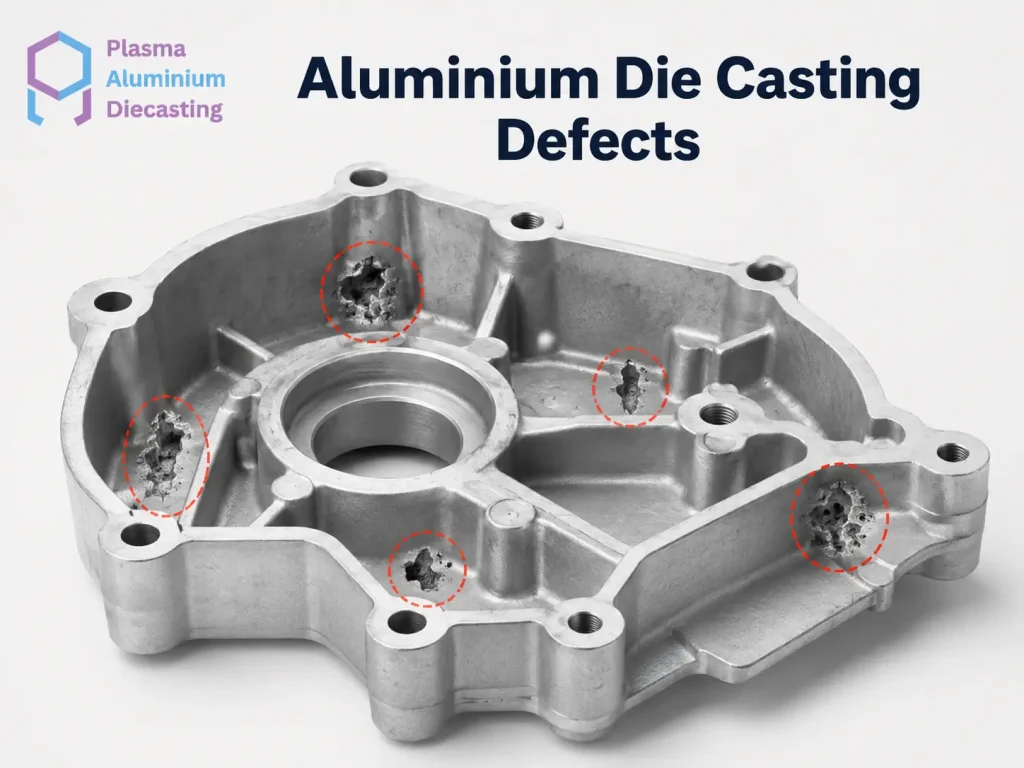
Aluminium die casting defects are flaws that appear on the surface or inside a cast part and reduce its strength, sealing or appearance. If you buy cast components, these defects decide whether your parts pass inspection or come back as scrap. The good news is simple. Almost every defect has a known cause, and most can be prevented before tooling is even cut. This guide walks you through the common defects, why they happen, how to spot them, and how to stop them, written for buyers and engineers rather than press operators.
We work with manufacturers across the Pune and Chakan belt every day, so the advice here is practical and tied to how parts actually get made and accepted in India.
Table of Contents
- What Are Aluminium Die Casting Defects?
- Why Defects Matter to You
- Surface Defects
- Internal Defects
- Dimensional Defects
- How to Diagnose a Defect
- How to Prevent Defects: Step by Step
- Common Mistakes Buyers Make
- Myth vs Fact
- FAQs
What Are Aluminium Die Casting Defects?
A defect is any feature of a casting that falls outside the agreed quality standard. In aluminium high pressure die casting, metal is injected into a steel die at high speed and pressure. That speed is what makes the process fast and precise. It is also what creates most defects when something is slightly off.
Defects fall into three broad groups. Surface defects you can see with your eyes. Internal defects hide inside the part and need X-ray to find. Dimensional defects mean the part is the wrong size or shape. Each group has different causes and different fixes.

Why Defects Matter to You
Defects are not just a cosmetic worry. They hit your cost, your timeline and your reputation. A part that leaks in the field is far more expensive than one caught at the press.
Here is where defects quietly drain money:
- Scrap. Rejected parts are pure loss of metal, energy and machine time.
- Rework. Some parts can be saved, but rework adds cost and delay.
- Line stoppage. A bad batch can halt your assembly line.
- Warranty claims. Field failures are the most costly outcome of all.
- Lost trust. Repeated quality issues push customers to other suppliers.
Surface Defects
Surface defects are the ones you notice first because they are visible. They often signal a deeper process problem, so they are worth taking seriously even when the part still works.
Flash
Flash is a thin fin of aluminium at the parting line where metal escapes between die halves. It is caused by worn dies, low clamping force or excess injection pressure. The fix is trimming during finishing, plus correcting the root cause so it does not return. For more on this, see our guide on die casting flash trimming and why it matters.
Cold Shut and Misrun
A cold shut is a weak seam where two streams of metal meet but do not fuse. A misrun is an incompletely filled part. Both come from metal that is too cold, poor gating or slow filling. Raising melt temperature and improving gate design usually solves them.
Blistering
Blisters are raised bumps that appear after the part is heated, often during powder coating. They form when gas trapped near the surface expands. Controlling porosity and venting prevents them.
Flow Marks and Soldering
Flow marks are surface lines from uneven metal flow. Soldering is aluminium sticking to the die face. Better thermal control, die coatings and flow management reduce both.
Internal Defects
Internal defects are more dangerous because you cannot see them. They need X-ray or pressure testing to detect, and they often cause failures in service rather than at the press.
Gas Porosity
Gas porosity shows up as smooth, rounded voids from trapped air or gas. It is the single most common internal defect in aluminium die casting. Degassing the melt, smoother gating and vacuum assist all reduce it. We cover this in depth in our guide on porosity in aluminium die casting.
Shrinkage Porosity
Shrinkage voids form as thick sections cool and contract last. Even wall thickness and better feeding reduce them.
Inclusions
Inclusions are bits of oxide or foreign material trapped in the metal. Clean melt practice and good filtration keep them out.
Hot Tears and Cracks
Hot tears form when a part contracts but cannot move freely during cooling. Sharp section changes and rapid cooling make them worse. Smoother part geometry helps.
Dimensional Defects
Sometimes the part is sound but the wrong size. Warping, sink marks and out-of-tolerance features fall here. Causes include uneven cooling, die wear and poor part design. Stable thermal control and regular die maintenance keep dimensions in check. A capable supplier verifies critical dimensions with CMM or calibrated gauges.
Defect Quick-Reference Table
| Defect | Type | Main cause | Primary fix |
|---|---|---|---|
| Flash | Surface | Worn die, low clamp force | Trim, restore die, set pressure |
| Cold shut | Surface | Cold metal, poor gating | Raise temperature, fix gates |
| Blistering | Surface | Trapped gas expanding | Control porosity and venting |
| Gas porosity | Internal | Trapped air, hydrogen | Degas, vent, vacuum assist |
| Shrinkage | Internal | Thick sections, poor feed | Even walls, better feeding |
| Inclusions | Internal | Dirty melt, oxides | Clean melt, filtration |
| Warping | Dimensional | Uneven cooling | Thermal control, fixturing |
How to Diagnose a Defect
Finding the defect is only half the job. You also need to find its cause. Use a layered approach, moving from simple checks to detailed ones.
- Visual inspection. Catches surface defects and obvious flaws fast.
- X-ray radiography. Reveals internal porosity, shrinkage and inclusions.
- Pressure leak testing. Confirms whether sealed parts hold pressure.
- Dimensional check. CMM or gauges verify size against the drawing.
- Sectioning. Cutting open a sample confirms internal findings.
For a full buyer checklist, read our guide on how to inspect aluminium die cast parts for quality.
How to Prevent Defects: Step by Step
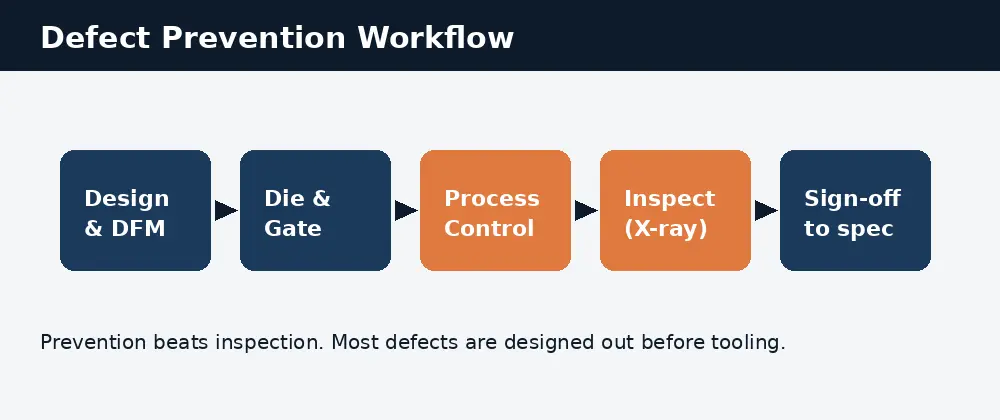
Prevention always beats inspection. The earlier a defect is designed out, the cheaper it is. Here is the workflow a strong supplier follows.

- Design and DFM review. Even wall thickness, generous radii and proper draft remove many defects at the source.
- Die and gate design. Balanced runners and good venting cut turbulence and trapped air.
- Process control. Correct shot speed, pressure, melt temperature and die temperature keep the fill clean.
- Inspection. X-ray and leak testing on an agreed sampling plan confirm quality.
- Sign-off to spec. Parts are accepted against a written standard, so there is no dispute.
Expert Tips
- Agree acceptance standards in writing before tooling starts.
- Mark critical and sealing zones on your drawing.
- Ask for a first-article inspection report, not just sample parts.
- Choose low pressure die casting for high-integrity structural parts.
Common Mistakes Buyers Make
- No written standard. Without an agreed acceptance level, every dispute becomes a fight.
- Judging only the surface. A clean exterior can still hide internal porosity.
- Ignoring part design. Many defects are baked in by the part geometry, not the press.
- Skipping first-article approval. This is your cheapest chance to catch problems early.
Myth vs Fact
| Myth | Fact |
|---|---|
| A defect-free casting is possible | Some porosity is normal. The goal is control within limits, not zero. |
| If it looks good, it is good | Internal defects are invisible. X-ray is the only sure check. |
| Defects are always the press operator’s fault | Many start in part design or die design, long before production. |
| Cheaper parts mean the same quality | Lower price often means looser control and higher defect risk. |
Conclusion
Aluminium die casting defects are predictable, and that is good news. When you understand the common surface, internal and dimensional defects, you can ask the right questions and set the right standards. The suppliers who win are the ones who prevent defects through design and process control, then prove quality through inspection.
If you want cast parts that pass inspection the first time, work with a manufacturer who treats defect control as a discipline, not an afterthought. Book your consultation today to discuss your part, your tolerances and your quality standards with the Plasma Aluminium Diecasting team.
Frequently Asked Questions
What are the most common aluminium die casting defects?
The most common are gas porosity, shrinkage porosity, flash, cold shut, inclusions and blistering. Porosity is the single most frequent internal defect, while flash is the most common surface defect.
What causes defects in aluminium die casting?
Most defects come from three sources. These are part or die design issues, process parameters like shot speed and temperature, and melt quality. Turbulent high-speed filling and trapped gas cause many of them.
Can aluminium die casting defects be completely eliminated?
No. Some level of porosity is normal in die casting. The realistic goal is to control defects within the acceptance limits set for the function of the part, then verify with inspection.
How are internal die casting defects detected?
Internal defects are found with X-ray radiography and, for complex parts, CT scanning. Pressure leak testing confirms sealing, and sectioning of sample parts verifies the results.
How can I prevent defects in my cast parts?
Prevent defects by reviewing part design for even wall thickness, using good die and gate design, controlling process parameters, and agreeing inspection standards before tooling begins.
What is the difference between surface and internal defects?
Surface defects like flash and cold shut are visible to the eye. Internal defects like porosity and inclusions hide inside the part and need X-ray to detect.
Does low pressure die casting reduce defects?
Yes. Low pressure die casting fills the die with a calm laminar flow that traps less gas than high pressure die casting, so it produces fewer gas porosity defects in structural parts.
What should I agree with my supplier to avoid defect disputes?
Agree the acceptance standard, the critical zones on the drawing, the inspection method and frequency, and what happens to borderline parts. Put it all in writing before production.
Are die casting defects a sign of a bad manufacturer?
Not always. Some defects are normal and controllable. A good manufacturer is one who prevents defects through design and process control and proves quality with documented inspection.
How much do defects cost a business?
The cost rises the later a defect is found. Scrap at the press is the cheapest. A field failure that triggers a warranty claim or a recall is by far the most expensive outcome.
Reviewed by the Plasma Aluminium Diecasting engineering team. Plasma serves buyers across the Pune, Chakan and Ranjangaon industrial corridor with an IATF 16949 aligned quality system.

Prasanna Kumar Tiwari
Plasma Aluminium Diecasting was established after analyzing the worldwide surge in manufacturing demand across diverse sectors — from automobiles to FMCG, Oil & Gas, and Pharma. To meet this growing need, we provide a comprehensive range of precision-engineered products and industrial solutions that streamline production and enhance efficiency. As a Leading Aluminium Die Casting Manufacturer in Pune, our commitment lies in delivering innovative, technology-driven, and cost-effective solutions tailored for modern industries.