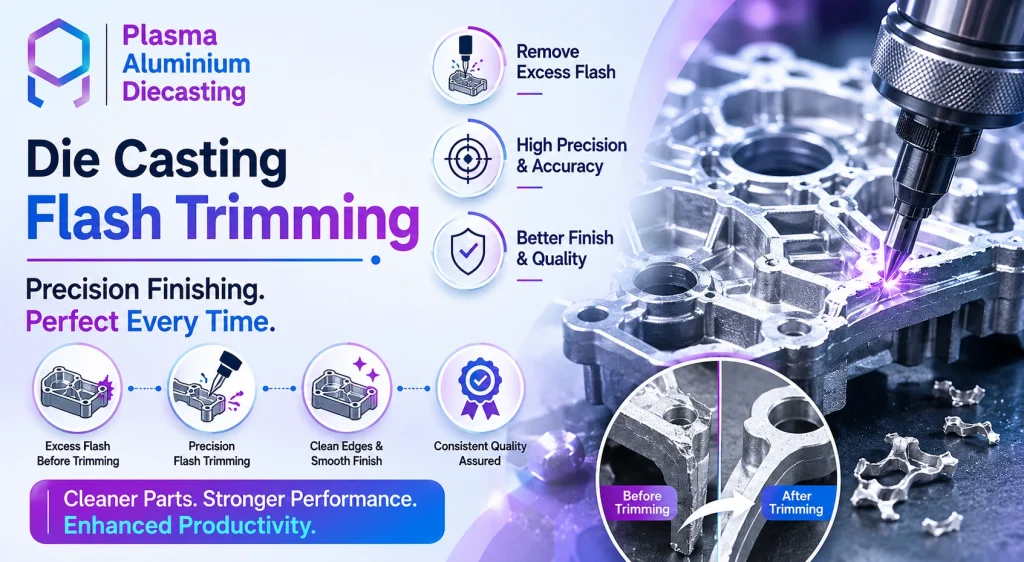
| ► Flash is a thin fin of aluminium formed at the parting line, gate, vent or ejector pin locations when molten metal penetrates the gap between die components during injection — a normal occurrence that must be controlled and removed. |
| ► Flash thickness at the parting line ranges from hairline (less than 0.1 mm) in a well-maintained die to 1 to 3 mm in a worn or poorly clamped die — acceptance criteria are specified on the customer drawing or quality plan. |
| ► Flash trimming removes excess material to restore the part to drawing dimensions and prevent assembly interference — untrimmed flash can prevent seating of mating faces, damage seals and create sharp edge hazards. |
| ► Trim dies (custom steel tooling in hydraulic or mechanical presses) are the highest-quality and most repeatable flash removal method — cycle time is 2 to 5 seconds per part and consistency is excellent. |
| ► Hand deburring with files, knives and rotary tools is used for lower-volume or complex geometry parts — it is labour-intensive and less consistent than trim die trimming. |
| ► Vibratory bowl deburring processes batches of small die cast parts simultaneously with abrasive media — suitable for burr removal and edge radiusing but not for heavy parting-line flash on large parts. |
| ► Flash prevention at source (maintaining die parting face flatness through preventive maintenance) is always more cost-effective than post-cast trimming — a well-maintained die produces flash within acceptance limits without trimming. |
FLASH TRIMMING METHODS
| Method | Application | Cycle Time | Consistency | Cost |
| Trim die (hydraulic press) | Parting line flash, gate removal | 2 to 5 sec/part | Excellent | Moderate tooling + low labour |
| Trim die (mechanical press) | High-volume, simple flash | 1 to 3 sec/part | Excellent | Moderate tooling + low labour |
| Hand deburring (file/knife) | Complex geometry, low volume | 30 to 120 sec/part | Variable | Low tooling + high labour |
| Rotary deburring tool | Internal features, threaded area | 15 to 60 sec/part | Moderate | Low |
| Vibratory bowl deburring | Small parts, batch processing | 30 to 90 min/batch | Good for edges, not heavy flash | Low |
| Cryogenic deflashing | Rubber inserts, small parts | Batch process | Good | Moderate-high |
| CNC trimming | Aerospace/precision, complex | 5 to 30 min/part | Excellent | High |
| Metric | Data | Source |
| Flash acceptance criterion (automotive Tier-1) | 0 to 0.3 mm height at parting line | Customer standard |
| Flash height from worn die (end of life) | 1 to 3 mm typical | Industry estimate |
| Trim die cycle time (hydraulic press) | 2 to 5 seconds per part | Industry practice |
| Flash prevention cost vs trimming cost | Prevention 3 to 5x cheaper than trimming | Industry estimate |
| Die parting face maintenance interval | Every 20,000 to 30,000 shots | Industry practice |
| Flash-related rejection rate (incoming inspection) | 1 to 5 percent of lots with worn tooling | Industry estimate |
| Trim die tooling cost (standard bracket) | INR 1.5 to 5 lakh | Industry estimate |
Introduction: Flash Is Normal — Uncontrolled Flash Is a Quality Problem
Die casting flash is a fact of the process. Every HPDC cycle injects aluminium at high pressure into a die that has a parting line gap — however tight that gap is — and some metal will penetrate it to form a thin fin on the parting line. This is normal and expected. The questions that matter are: how thick is the flash? Is it within the drawing acceptance criterion? And if it exceeds the criterion, how is it removed to restore the part to drawing compliance? Understanding flash causes, acceptance criteria and trimming methods helps both suppliers and buyers manage this aspect of die casting quality effectively.
Where Flash Forms and Why
Flash forms wherever there is a gap between die components at the time of injection. The primary locations are: the parting line (the interface between the fixed and moving die halves), core pins (gaps between the core pin shank and the die bore), ejector pins (minute gaps between the pin and its hole), vents (the thin channels that allow air to escape from the cavity) and gates (the junction between the runner system and the cavity).
Flash at the parting line is the most common and most visible type. Its thickness is determined by the clamp force minus the opening force from injection pressure on the projected area of the casting. A correctly clamped die with a flat parting face produces hairline flash (less than 0.1 mm) or no visible flash at all. Flash increases as parting face flatness deteriorates through wear, as clamp force settings drift, or if the machine is undersized for the shot.
Flash Acceptance Criteria
Flash acceptance criteria vary by surface function and customer specification. For most general industrial applications, flash height up to 0.3 to 0.5 mm on the parting line is acceptable. For sealing surfaces (gasket faces, O-ring grooves), zero flash is required. For assembly interfaces where mating faces must contact precisely, flash above 0.1 mm may prevent correct seating and is rejectable. The drawing or quality plan should specify which surfaces have which criterion.
Incoming inspection of die cast parts checks flash visually at 100 percent of parts and measures flash height with a depth gauge on sample parts from each lot. Lots with flash heights consistently at or near the acceptance limit are flagged for a corrective action request to the supplier to inspect and repair the die parting face.
Trim Dies: The Production Trimming Solution
For medium-to-high volume production parts, trim dies are the correct flash removal tool. A trim die is a custom steel press tool designed to remove flash at the parting line and gate locations in a single press stroke. The trim die is installed in a hydraulic or mechanical press and the die cast part is loaded manually or automatically into the nest. A single stroke removes all parting-line flash simultaneously, consistent and fast.
Trim die cycle time is 2 to 5 seconds per part — much faster than hand deburring. Consistency is excellent: every part is trimmed to the same geometry. Trim die tooling cost is INR 1.5 to 5 lakh for a typical automotive bracket, justified for production volumes above 5,000 to 10,000 pieces per year. For lower volumes, hand deburring with hand tools is more cost-effective despite higher labour content.
Flash Prevention: Better Than Trimming
The most cost-effective flash management strategy is prevention. Flash prevention requires: correct machine clamping force for the die projected area and injection pressure, regular parting face maintenance (lapping every 20,000 to 30,000 shots to restore flatness), correct shot parameters to avoid over-pressuring the cavity, and proper die clamping alignment to avoid parting face step errors.
A well-maintained die in a correctly sized machine with calibrated shot parameters produces flash within the drawing acceptance criterion throughout its production life. The cost of preventive die maintenance (INR 50,000 to 2 lakh per cycle) is a fraction of the cumulative labour cost of trimming, re-inspection and non-conformance management if flash is not controlled at source.
Post-Trim Quality Verification
After trimming, parts should be re-inspected to verify that: flash has been removed to within the acceptance criterion, the trim has not left a sharp edge that violates the edge break specification, and the trim die has not damaged any feature adjacent to the parting line. For high-volume automotive programmes, post-trim dimensional verification is included in the in-process quality plan.
FAQ
Q: Is all die casting flash the same? Are there different types?
Flash is classified by location and mechanism. Parting-line flash is the most common — a thin fin at the die split. Core-pin flash appears as a ring or fin around holes and pins. Ejector-pin flash is a raised disc at each ejector pin location. Vent flash fills the thin vent channels (typically hairline and acceptable). Gate vestige is the remnant of the in-gate after gate breaking — it is a controlled dimension, not flash. Each type has its own removal method and acceptance criterion.
Q: Can flash be a defect that causes field failure?
Yes, in specific circumstances. Flash on a sealing surface prevents gasket or O-ring seating, causing leaks. Flash on a bearing or assembly interface prevents dimensional compliance in the assembled product. Flash that detaches during service can contaminate lubricant systems or cause valve blockage in hydraulic components. Flash on safety-critical surfaces should be specified as zero flash at drawing level.
Q: Does Plasma Aluminium Diecasting include flash trimming in the standard supply scope?
Yes. For parts where the drawing specifies flash criteria that require trimming, Plasma Aluminium Diecasting includes flash trimming as part of the standard manufacturing scope. Trim die tooling cost is quoted separately if a dedicated trim tool is required. For hand-deburrable specifications, trimming labour is included in the per-piece price. Contact us to clarify the trimming scope for your specific part.
Q: How often should die parting faces be re-lapped to prevent flash?
The standard preventive maintenance interval for parting face lapping is every 20,000 to 30,000 shots. High-pressure parts (complex geometries with high projected areas running at high injection pressure) may require more frequent lapping. The correct interval is determined by flash measurement trend: if parting-line flash height is increasing over successive production runs, it is time for parting face maintenance regardless of shot count.
Q: What edge break standard should we specify for trimmed die cast parts?
Standard edge break for aluminium die cast automotive parts is 0.2 to 0.5 mm chamfer or radius on all machined and trimmed edges. For cosmetic surfaces, a smoother 0.5 to 1.0 mm radius is specified. For safety-critical sharp-edge hazard prevention (operator handling), 0.5 mm minimum edge break on all trim and machined edges is standard. The drawing should specify edge break explicitly on critical surfaces and can reference ‘all edges 0.3 to 0.5 mm break unless otherwise shown’ for general compliance.
Conclusion
Flash trimming is an essential finishing operation in aluminium die casting that restores parts to drawing-compliant dimensions and prevents assembly, sealing and safety issues in the downstream application. Trim dies provide the most efficient and consistent flash removal for medium-to-high volume programmes; hand deburring serves lower volumes and complex geometries. Plasma Aluminium Diecasting manages flash through preventive die maintenance to minimise occurrence, and includes flash trimming in the manufacturing scope for parts with trimming requirements.
Contact Plasma Aluminium Diecasting
Specifications and pricing vary by order volume, material grade and finish requirements. Contact the team for a detailed technical datasheet and quote.

Prasanna Kumar Tiwari
Plasma Aluminium Diecasting was established after analyzing the worldwide surge in manufacturing demand across diverse sectors — from automobiles to FMCG, Oil & Gas, and Pharma. To meet this growing need, we provide a comprehensive range of precision-engineered products and industrial solutions that streamline production and enhance efficiency. As a Leading Aluminium Die Casting Manufacturer in Pune, our commitment lies in delivering innovative, technology-driven, and cost-effective solutions tailored for modern industries.