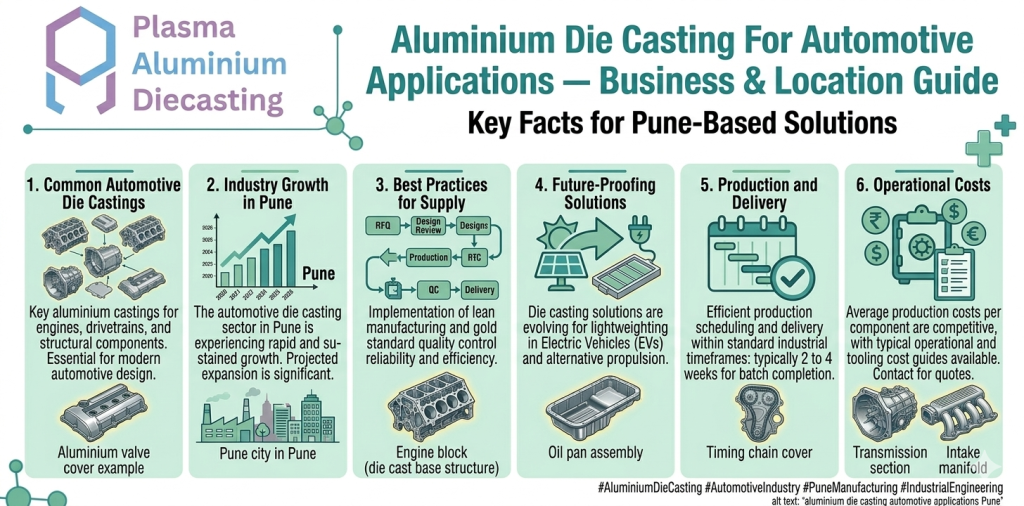
| ► Automotive and two-wheeler manufacturing is the largest end-use sector for aluminium die casting in Pune, accounting for approximately 60 to 65 percent of total die casting demand in the Chakan-Pimpri-Chinchwad-Ranjangaon corridor. |
| ► Electric vehicle (EV) production is the fastest-growing demand driver for aluminium die casting in India, with battery housing, motor covers, inverter enclosures and structural frames driving new programme volumes at 25 to 40 percent annual growth. |
| ► Telecom infrastructure (4G and 5G base stations, antenna housings, junction boxes) is a significant and growing sector for aluminium die cast enclosures, driven by India’s BharatNet and 5G rollout. |
| ► Industrial equipment (pumps, compressors, gearboxes, hydraulic system housings) uses aluminium die casting for housing components where weight reduction and pressure-tightness are required. |
| ► Agriculture and farm machinery (tractor gearbox covers, PTO housing, irrigation pump bodies) represent a growing market for aluminium die casting in Maharashtra, where Mahindra Tractors and TAFE supply chains are active. |
| ► General engineering (lighting fixtures, HVAC housings, electrical enclosures, consumer appliances) contributes approximately 10 to 15 percent of Pune region die casting demand in non-automotive sectors. |
| ► Plasma Aluminium Diecasting’s customer base spans automotive, EV, telecom, industrial and agricultural sectors — providing multi-sector supply capability from a single Chakan MIDC facility. |
SECTOR DEMAND OVERVIEW
| Sector | Share of Pune Die Casting Demand | Key Applications | Growth Trend |
| Automotive (ICE vehicles) | 45 to 50 percent | Engine brackets, gearbox, HVAC, brakes | Stable to moderate growth |
| Two-wheelers | 12 to 15 percent | Engine cases, covers, brackets | Stable |
| Electric vehicles (EV) | 8 to 12 percent (growing fast) | Battery housings, motor covers, frames | 25 to 40% CAGR |
| Telecom infrastructure | 5 to 8 percent | Antenna housings, enclosures, junction boxes | 15 to 20% CAGR |
| Industrial equipment | 8 to 12 percent | Pump/compressor/gearbox housings | Moderate growth |
| Agriculture machinery | 3 to 5 percent | Tractor housings, PTO covers, pump bodies | Moderate growth |
| General engineering | 8 to 12 percent | Lighting, HVAC, electrical enclosures | Stable |
| Metric | Data | Source |
| Aluminium die casting demand in India (2024) | INR 18,000 to 22,000 crore | ACMA / CII |
| Automotive share of die casting demand | 60 to 65 percent | ACMA |
| EV aluminium die casting demand growth rate | 25 to 40 percent CAGR | IBEF EV Sector Report |
| Telecom infrastructure investment (India 2023-2025) | INR 1,40,000 crore (5G rollout) | TRAI |
| Agriculture machinery production growth India | 8 to 10 percent CAGR | MHI |
| Industrial equipment aluminium content growth | 6 to 9 percent CAGR | CII |
| Pune region share of India die casting production | 12 to 15 percent of national | ACMA regional data |
Introduction: Pune as India’s Die Casting Demand Centre
Pune is India’s most concentrated location for aluminium die casting consumption because it hosts the country’s densest cluster of automotive OEMs, Tier-1 suppliers and industrial manufacturers within a 60 km radius. Understanding which industries use aluminium die casting — and which specific applications within each industry — helps OEM buyers, Tier-1 sourcing teams and new entrants identify the right supply chain partners and set appropriate quality and specification expectations for their sector.
Automotive: The Dominant Sector
Passenger cars, utility vehicles and commercial vehicles manufactured at Pune’s OEM plants (Tata Motors, Volkswagen, Mercedes-Benz, Mahindra, Force Motors, Bajaj, JCB) consume aluminium die casting components across a wide range of applications. Engine brackets — the mounting structures for alternators, power steering pumps, compressors and ancillary equipment — are the highest volume die cast application by unit count. Transmission housings, clutch covers, HVAC system housings, brake caliper brackets and structural body hardware are other major automotive applications.
The transition from cast iron to aluminium in engine bay components is ongoing. India’s CAFE fuel efficiency targets are accelerating this substitution as OEMs seek weight reduction to meet fleet average consumption targets. Each vehicle platform refresh typically introduces 3 to 8 new aluminium die cast applications replacing cast iron or fabricated steel components.
Two-Wheelers: High Volume, Cost-Sensitive
Bajaj Auto (Chakan plant), TVS (Hosur supply chain) and Honda Motorcycle supply chains in the Pune region use aluminium die casting for engine crankcases, cylinder heads, covers and brackets. Two-wheeler die casting is extremely cost-sensitive and high-volume — production volumes of 500,000 to 2,000,000 parts per year per model are common for major platforms. Multi-cavity dies and fully automated HPDC cells are standard in two-wheeler die casting supply.
Electric Vehicles: The Growth Driver
EV production in India is growing at 25 to 40 percent annually (IBEF data) and aluminium die casting content per EV is significantly higher than per ICE vehicle. Battery module housings (aluminium die cast box structures housing the cell modules) are large, complex and safety-critical. Motor housings (the structural enclosures for the traction motor), inverter housings (the enclosures for the power electronics), and structural battery trays (the load-bearing floor structure of battery-electric vehicles) are all major HPDC applications.
EV die casting programme volumes are growing rapidly as Tata Motors, Mahindra Electric and new entrants scale production. The quality requirements for EV structural die castings are demanding — tight dimensional tolerances, low porosity and thermal management features (integral cooling channels) are commonly specified.
Telecom Infrastructure: 5G Drives Enclosure Demand
India’s 5G rollout and BharatNet rural broadband programme have driven significant demand for aluminium die cast telecom enclosures. Base station housings, antenna junction boxes, power amplifier cooling fins and remote radio unit (RRU) enclosures are all aluminium HPDC components because aluminium’s thermal conductivity (96 W/mK vs approximately 0.2 for plastics) is essential for managing heat dissipation in high-power outdoor electronics.
Telecom enclosure die castings require excellent IP66/IP67 sealing face flatness (for gasket sealing), good thermal conductivity (for heat spreading), and in many cases, EMI shielding through wall thickness and geometry design. These requirements are well within the capability of HPDC aluminium with post-cast machining of sealing faces.
Industrial Equipment: Pumps, Compressors and Gearboxes
Pune’s industrial equipment manufacturers (pump OEMs, compressor manufacturers, hydraulic equipment suppliers) use aluminium die casting for housing and bracket components where weight reduction, corrosion resistance and near-net-shape dimensional accuracy are valued. Pump volute housings, compressor valve covers, gearbox covers and hydraulic manifold blocks are common applications. Pressure-tight casting requirements (leak testing at 5 to 30 bar) are common in this sector, requiring low-porosity HPDC with post-cast impregnation in some applications.
Agriculture Machinery: Growing Maharashtra Market
Maharashtra’s agricultural sector and the concentration of tractor OEMs (Mahindra Tractors in Kandivali, TAFE in Chennai with Pune supply chains, Force Motors) creates steady demand for aluminium die cast gearbox components, PTO (power take-off) housings, hydraulic pump bodies and instrument panel structures. Agricultural applications are typically less demanding in tolerance and surface finish than automotive Tier-1 applications, but require corrosion resistance for field conditions and mechanical durability for continuous heavy-duty operation.
FAQ
Q: Does Plasma Aluminium Diecasting supply to the EV sector?
Yes. Plasma Aluminium Diecasting supplies aluminium HPDC components to EV OEM supply chains in the Pune region, including motor housings, inverter covers and structural brackets. EV applications have demanding dimensional and quality requirements that our PPAP-capable quality system is designed to meet. Contact us to discuss your EV programme requirements.
Q: What surface treatment is standard for aluminium die cast telecom enclosures?
Telecom enclosures are typically powder coated (polyester or epoxy-polyester hybrid) to achieve IP66 corrosion resistance, with parylene or conformal coating for internal electronics protection in some applications. Sealing face surfaces are machined to Ra 1.6 to 3.2 micrometres for gasket sealing. Antenna housings may require specific colour finishes for RAL colour codes specified by the telecom OEM.
Q: Can Plasma supply die cast parts for agricultural equipment OEMs near Pune?
Yes. Agricultural equipment components are within our standard capability range. Typical agricultural applications (gearbox covers, pump bodies, bracket assemblies) are less dimensionally demanding than automotive Tier-1 parts, allowing competitive pricing. We have supplied to agricultural equipment customers in Maharashtra and can provide samples and quotations for new programmes.
Q: What is the minimum part size and complexity that Plasma Aluminium Diecasting handles?
We produce parts from approximately 50 grams to 8 kg in single-cavity and multi-cavity tools. Part complexity ranges from simple brackets with 2 to 4 features to complex housings with internal passages, threaded inserts and multiple machined interfaces. For very small parts (below 100 g), multi-cavity dies are standard. For very large parts (above 8 kg), we recommend contacting us to discuss machine capacity and tooling feasibility.
Q: Does Plasma Aluminium Diecasting offer volume discounts for large annual programmes?
Yes. Unit pricing reflects material, processing and overhead allocation; at higher annual volumes, fixed overhead is spread over more pieces and material purchasing efficiency improves. A firm volume commitment at the time of programme planning allows us to quote the most competitive pricing for your specific annual quantity.
Conclusion
Aluminium die casting serves virtually every major manufacturing sector in Pune — automotive, two-wheelers, EV, telecom, industrial equipment, agriculture and general engineering. Each sector has specific quality, dimensional and surface finish requirements, but all share the common benefits of aluminium HPDC: weight reduction, dimensional accuracy, cycle time efficiency and full recyclability. Plasma Aluminium Diecasting’s multi-sector capability from its Chakan MIDC facility makes it a versatile supply partner for buyers across Pune’s diverse industrial base.
Contact Plasma Aluminium Diecasting
Specifications and pricing vary by order volume, material grade and finish requirements. Contact the team for a detailed technical datasheet and quote.

Prasanna Kumar Tiwari
Plasma Aluminium Diecasting was established after analyzing the worldwide surge in manufacturing demand across diverse sectors — from automobiles to FMCG, Oil & Gas, and Pharma. To meet this growing need, we provide a comprehensive range of precision-engineered products and industrial solutions that streamline production and enhance efficiency. As a Leading Aluminium Die Casting Manufacturer in Pune, our commitment lies in delivering innovative, technology-driven, and cost-effective solutions tailored for modern industries.