| ► Aluminium’s density is 2.71 g/cm3 compared to cast iron at 7.2 g/cm3 — a die cast aluminium part weighs 60 to 65 percent less than a cast iron equivalent for the same design geometry. |
| ► HPDC aluminium achieves tensile strength of 220 to 320 MPa (ADC12), enabling designers to achieve equivalent structural performance with 30 to 50 percent weight reduction vs cast iron through wall optimisation. |
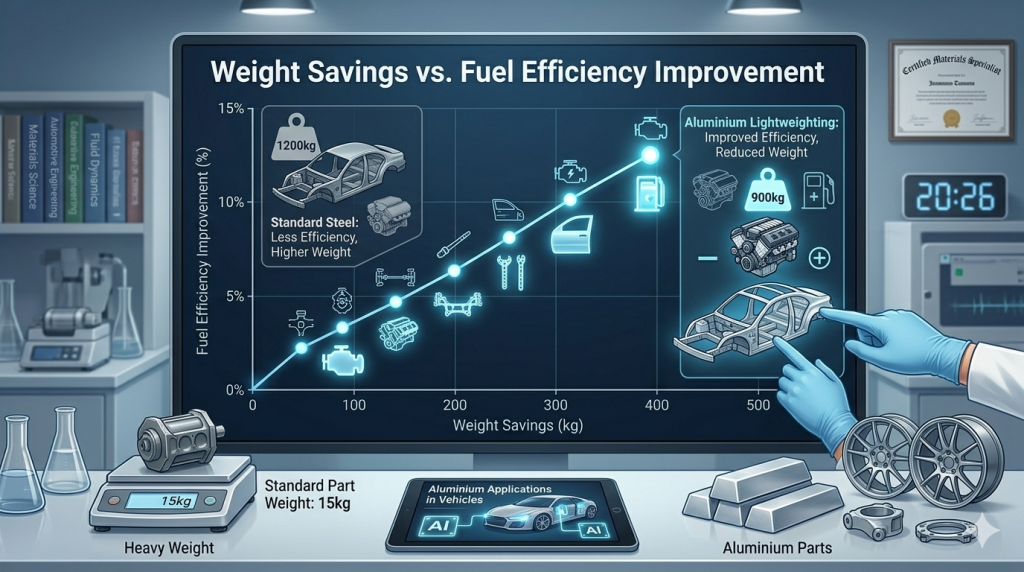
| ► Automotive industry data: every 100 kg reduction in vehicle kerb weight improves fuel efficiency by 6 to 8 percent for ICE vehicles and extends EV range by 6 to 11 km (IBEF/SIAM data). |
| ► India’s CAFE (Corporate Average Fuel Economy) standards require passenger vehicle fleet average to reach 4.79 litres per 100 km by FY 2027 — lightweighting is a primary compliance strategy for OEMs. |
| ► Die casting enables integration of multiple steel or cast iron components into a single aluminium casting, reducing assembly cost and eliminating fasteners that add weight. |
| ► Aluminium die cast components are 100 percent recyclable with no loss of mechanical properties, making them CAFE-compliant and aligned with India’s circular economy policies. |
| ► Plasma Aluminium Diecasting’s Chakan facility supplies lightweighting aluminium die cast components to automotive OEMs and Tier-1 suppliers across Pune, Pimpri-Chinchwad and Ranjangaon. |
MATERIAL PROPERTIES COMPARISON
| Property | Aluminium HPDC (ADC12) | Grey Cast Iron | Weight Ratio |
| Density (g/cm3) | 2.71 | 7.2 | Al is 62% lighter |
| Tensile strength (MPa) | 220 to 280 | 150 to 250 | Comparable or higher |
| Yield strength (MPa) | 140 to 180 | N/A (brittle) | Al has defined yield |
| Elongation (%) | 1.5 to 3.0 | 0.5 to 1.0 | Al more ductile |
| Thermal conductivity (W/mK) | 96 | 46 to 50 | Al 2x better cooling |
| Corrosion resistance | Good (with coating) | Poor (oxidises) | Al significantly better |
| Machinability | Excellent | Good | Al faster cycle times |
| Recyclability | 100% fully recyclable | 100% but energy-intensive | Al preferred for ECA |
| Metric | Data | Source |
| Aluminium density vs cast iron | 2.71 vs 7.2 g/cm3 (62% lighter) | ASTM |
| Fuel efficiency gain per 100 kg weight reduction (ICE) | 6 to 8 percent | SIAM / IBEF |
| EV range extension per 100 kg reduction | 6 to 11 km (city cycle) | Industry estimate |
| India CAFE target FY2027 | 4.79 L/100 km fleet average | MHI |
| Aluminium content per passenger vehicle (India 2024) | 55 to 80 kg | ACMA |
| Aluminium content per passenger vehicle (target 2030) | 120 to 160 kg | CII Lightweighting Report |
| Component integration ratio (Al die casting vs steel fabrication) | 3 to 8 steel parts replaced per casting | Industry estimate |
Why Vehicle Weight Is a Compliance and Competitiveness Issue
Vehicle lightweighting is no longer a performance luxury — it is a regulatory compliance requirement for every automotive OEM operating in India. CAFE (Corporate Average Fuel Economy) standards under the Bureau of Energy Efficiency (BEE) require manufacturers to reduce fleet average fuel consumption to 4.79 litres per 100 km by FY 2027. For electric vehicle platforms, range extension targets make every kilogram of vehicle weight reduction directly valuable. Aluminium die casting is the primary manufacturing process enabling this lightweighting transition across India’s automotive sector.
The Physics of Lightweighting: Density Advantage
Aluminium’s density of 2.71 g/cm3 is 62 percent lower than grey cast iron (7.2 g/cm3) and 65 percent lower than steel (7.85 g/cm3). For a component of identical geometry, the aluminium die casting weighs 60 to 65 percent less. In practice, the weight saving is typically 30 to 50 percent in real programmes because aluminium’s lower modulus requires some wall thickness increase to maintain stiffness — but this is more than offset by the density advantage in most automotive applications.
HPDC aluminium (ADC12, A380) achieves tensile strength of 220 to 320 MPa — comparable to or higher than grey cast iron (150 to 250 MPa). This strength-to-weight ratio advantage is what enables aluminium to replace cast iron in structural applications. For brackets, housings, covers, manifolds and transmission cases, the strength requirement is met with aluminium at 35 to 50 percent of the cast iron part weight.
Fuel Efficiency Impact: Quantifying the Benefit
Industry data from SIAM and IBEF consistently shows that a 100 kg reduction in passenger vehicle kerb weight improves fuel efficiency by 6 to 8 percent in ICE vehicles under standard drive cycle conditions. For a 1,200 kg hatchback with a 5 litre per 100 km base consumption, a 100 kg lightweighting programme saves approximately 0.35 litres per 100 km — meaning a vehicle travelling 15,000 km annually saves approximately 52 litres of fuel per year. Multiplied across fleet volumes of 100,000 to 500,000 units, the aggregate fuel saving is significant.
For battery electric vehicles, range extension is the primary benefit. A 100 kg weight reduction typically extends range by 6 to 11 km on India’s urban drive cycle. As consumer range anxiety remains a significant EV adoption barrier, weight reduction in structural and body components directly improves the vehicle’s commercial proposition without requiring a larger battery pack — which itself adds weight and cost.
Component Integration: The Hidden Lightweighting Benefit
Die casting enables component integration — the consolidation of multiple separate stampings, castings or fabrications into a single aluminium casting. A typical automotive bracket assembly previously made from 4 to 6 stamped steel parts welded together can be replaced by a single aluminium HPDC casting with equivalent or superior structural performance at 40 to 50 percent of the assembly weight.
The weight saving from material substitution (aluminium vs steel/iron) is additive to the weight saving from component integration (fewer fasteners, brackets and joining elements). In complex assemblies, the combined effect can exceed 50 percent weight reduction. Additionally, component integration reduces assembly time, eliminates welding operations, reduces part number complexity and improves dimensional consistency.
CAFE Compliance: Aluminium as a Regulatory Strategy
India’s CAFE standards are based on the EU5 model and apply to passenger vehicles and light commercial vehicles. Fleet average fuel consumption targets will tighten further post-FY2027 under proposed BS7 equivalent standards. OEMs with a high proportion of cast iron components in their vehicles — engine blocks, transmission housings, suspension brackets, brake components — face significant CAFE compliance risk if lightweighting programmes are not implemented.
Aluminium die cast substitution of cast iron components is one of the fastest and most cost-effective CAFE compliance pathways. Unlike aerodynamic improvements (which require vehicle body redesign) or powertrain electrification (which requires significant platform investment), aluminium component substitution can be implemented incrementally, part by part, programme by programme, with relatively modest tooling investment per application.
Plasma Aluminium Diecasting’s Lightweighting Programme Support
Plasma Aluminium Diecasting provides DFM review for material substitution programmes that are transitioning from cast iron or steel fabrications to aluminium HPDC. Our engineering team evaluates the existing geometry, identifies areas where wall reduction is feasible with aluminium’s strength-to-weight advantage and calculates the weight saving per part. This DFM review is provided at the quotation stage at no charge.
FAQ
Q 1 : Which automotive components are most commonly switched from cast iron to aluminium die casting?
Engine brackets, gearbox housings, clutch housings, alternator brackets, power steering pump brackets, HVAC housings, EV motor housings and inverter covers are among the most commonly substituted components. Engine blocks in two-wheelers and small passenger cars are also increasingly aluminium HPDC. Suspension wishbones and structural body parts are typically aluminium but more commonly manufactured by gravity die casting or squeeze casting for better elongation and toughness.
Q 2: Does aluminium die casting achieve the same stiffness as cast iron?
Aluminium has a lower elastic modulus (70 GPa vs 100 to 170 GPa for grey iron), meaning that for equal wall thickness, an aluminium part is less stiff. However, stiffness-equivalent design with aluminium allows wall thickening and ribbing at strategic locations to recover stiffness. For most automotive bracket and housing applications, equivalent stiffness is achievable at 30 to 50 percent weight reduction vs cast iron.
Q 3: What is the cost comparison between cast iron and aluminium HPDC for the same component?
Aluminium HPDC is generally more expensive per kilogram than grey cast iron, but when cost is compared on a per-component basis (not per kilogram), aluminium is competitive or lower cost for most complex geometries because of lower machining cost, higher dimensional accuracy from die casting, and component integration benefits. For a full cost-of-quality comparison, ask Plasma Aluminium Diecasting to provide a cast iron substitution quotation.
Q 4 : Is die cast aluminium suitable for high-temperature engine components?
Die cast aluminium (A380, ADC12) has a service temperature limit of approximately 150 to 175 degrees C for sustained mechanical loading. It is suitable for most underbonnet applications (brackets, covers, housings) but not for components in direct contact with combustion gases or exhaust. Piston and cylinder applications use specialised high-silicon hypereutectic aluminium alloys with higher temperature capability.
Q 5 : Does Plasma Aluminium Diecasting work with OEM lightweighting programme engineers directly?
Yes. We work with OEM engineering teams at the programme definition stage to evaluate HPDC feasibility for cast iron substitution applications. DFM review, material recommendations, weight saving calculations and tooling cost estimates are all provided at the quotation stage.
Contact To Schedule a Technical Discussion.
Conclusion
Aluminium die casting is India’s automotive sector’s primary lightweighting technology, enabling 30 to 50 percent weight reduction vs cast iron while meeting CAFE fuel efficiency compliance targets and extending EV range. The combination of density advantage, comparable strength-to-weight ratio, component integration capability and full recyclability makes aluminium HPDC the material and process of choice for OEMs transitioning away from cast iron in brackets, housings, manifolds and structural applications. Plasma Aluminium Diecasting supports automotive lightweighting programmes from DFM review through production PPAP at its Chakan facility.

Prasanna Kumar Tiwari
Plasma Aluminium Diecasting was established after analyzing the worldwide surge in manufacturing demand across diverse sectors — from automobiles to FMCG, Oil & Gas, and Pharma. To meet this growing need, we provide a comprehensive range of precision-engineered products and industrial solutions that streamline production and enhance efficiency. As a Leading Aluminium Die Casting Manufacturer in Pune, our commitment lies in delivering innovative, technology-driven, and cost-effective solutions tailored for modern industries.