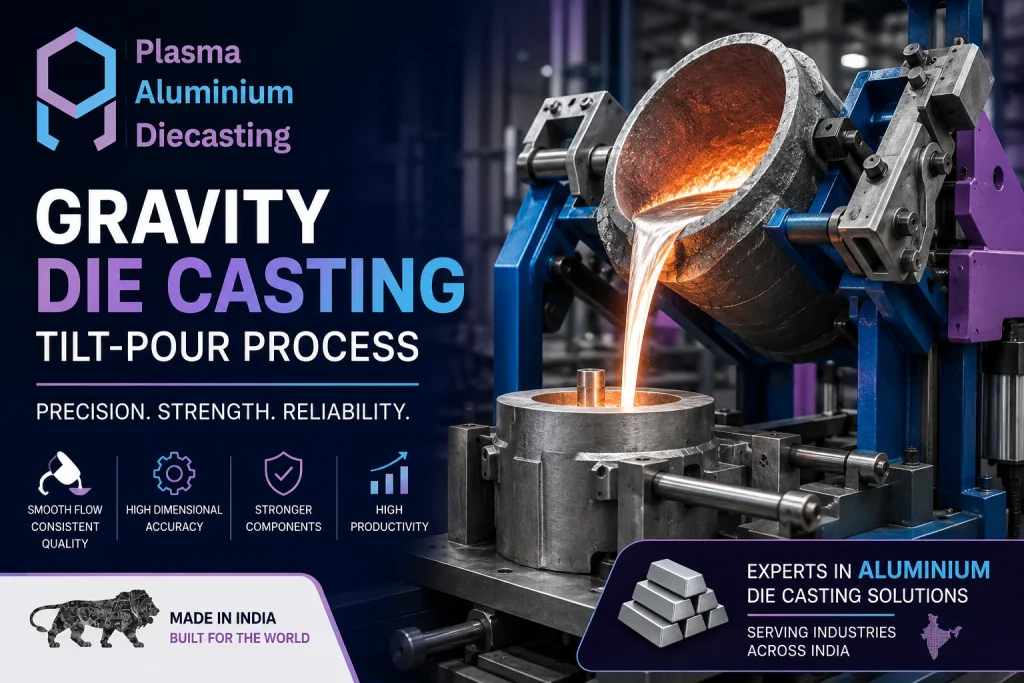
| ► Gravity die casting (GDC) using permanent metal dies achieves as-cast surface roughness of Ra 3 to 6 micrometres, versus Ra 12 to 25 micrometres for green sand casting — a 2 to 5 times improvement in surface quality. |
| ► GDC dimensional tolerances are CT7 to CT9 (ISO 8062), compared to CT11 to CT13 for sand casting — enabling significant reduction in post-cast machining stock allowance. |
| ► GDC permanent dies cost INR 2 to 15 lakh, versus essentially zero for sand casting patterns — GDC is cost-effective above approximately 500 to 2,000 pieces per year depending on part size. |
| ► GDC aluminium alloys (A356, LM6, LM25) produce mechanical properties 10 to 30 percent better than sand cast equivalents of the same alloy due to faster solidification in the metal die — finer grain structure and lower microporosity. |
| ► GDC cycle time is 3 to 8 minutes per cavity, versus 30 to 60 minutes for medium-size sand castings (including moulding time) — GDC is 5 to 15 times more productive at equivalent part complexity. |
| ► Surface finish improvement from GDC vs sand casting reduces secondary operations: machining stock is typically 1.0 to 1.5 mm for GDC vs 2.5 to 4 mm for sand casting, saving material and machining cost. |
| ► GDC cannot produce the very complex internal passages (undercuts, cored passages in multiple planes) that sand casting can achieve — part complexity is the main GDC limitation vs sand casting. |
PROCESS COMPARISON
| Parameter | Green Sand Casting | Gravity Die Casting (GDC) |
| Surface roughness (as-cast) | Ra 12 to 25 micrometres | Ra 3 to 6 micrometres |
| Dimensional tolerance | CT11 to CT13 (ISO 8062) | CT7 to CT9 (ISO 8062) |
| Tooling cost | Low (pattern only, INR 50k to 5L) | Moderate (INR 2L to 15L) |
| Cycle time (medium part) | 30 to 60 min (incl. mould) | 3 to 8 minutes |
| Minimum production volume | 1 piece | 200 to 500 pieces |
| Mechanical properties | Baseline (coarser grain) | 10 to 30% better (finer grain) |
| Max part weight | No limit (10g to tonnes) | 0.1 kg to 150 kg (practical) |
| Internal passage complexity | Very high (sand cores) | Limited to simple cores |
| Heat treatment | Yes (A356 sand cast) | Yes (A356 GDC) |
| Machining stock allowance | 2.5 to 4 mm | 1.0 to 1.5 mm |
| Metric | Data | Source |
| GDC surface roughness vs sand casting | 2 to 5 times better (Ra 3-6 vs 12-25) | Industry practice |
| GDC dimensional tolerance | CT7 to CT9 (ISO 8062) | ISO 8062 |
| Sand casting tolerance | CT11 to CT13 (ISO 8062) | ISO 8062 |
| Mechanical property improvement GDC vs sand (A356) | 10 to 30 percent higher tensile strength | ASTM B26/B108 |
| GDC cycle time vs sand casting | 5 to 15 times faster | Industry practice |
| Break-even volume GDC vs sand casting | 500 to 2,000 pieces/year | Industry estimate |
| GDC machining stock saving vs sand casting | 1 to 2.5 mm per surface | Industry practice |
Introduction: Why Surface Finish Matters More Than It Seems
Surface finish is not just a cosmetic concern in aluminium casting — it directly determines how much machining stock must be added to achieve a precision mating surface, whether the part can be powder coated without surface preparation, and how much time is spent in manual deburring and finishing. Sand casting and gravity die casting can both produce aluminium parts of similar weight and general shape, but the surface quality, dimensional consistency and mechanical properties differ significantly between the two processes. For buyers evaluating process selection, understanding these differences prevents the costly mistake of choosing sand casting for a programme where GDC would be more cost-effective.
Surface Finish: Why Metal Dies Beat Sand Moulds
The surface roughness of a casting is determined primarily by the smoothness of the mould surface. Green sand moulds are made from compacted sand bonded with clay — the sand grains produce a textured surface on the casting in direct contact with the mould. Even fine-grain foundry sand produces an as-cast surface roughness of Ra 12 to 25 micrometres, which is visible as a rough, grainy texture.
GDC permanent dies are made from H13 or grey cast iron tooling polished to Ra 0.4 to 1.6 micrometres on the cavity surface. The aluminium casting in contact with this smooth metal surface replicates the die surface with some reduction in quality (release agent, cooling rate and metal flow all affect transfer), resulting in as-cast Ra of 3 to 6 micrometres. This is 2 to 5 times smoother than sand casting — a significant difference that reduces machining preparation time and improves the adhesion of powder coat and paint.
Dimensional Accuracy: Tolerances and Machining Stock
ISO 8062 casting tolerance grades define the dimensional accuracy achievable by each casting process. Sand casting achieves CT11 to CT13, meaning a 100 mm dimension has a casting tolerance of plus or minus 1.5 to 2.5 mm. GDC achieves CT7 to CT9, meaning the same 100 mm dimension has a tolerance of plus or minus 0.4 to 0.8 mm. This tighter tolerance reduces the machining stock that must be added to the casting to guarantee that the finished machined dimension is achievable — GDC requires only 1.0 to 1.5 mm machining stock per surface versus 2.5 to 4 mm for sand casting.
Reduced machining stock means less material in the casting (lighter part, lower alloy cost), fewer machining passes and shorter machining cycle time. For a bracket with 5 machined faces, the combined stock reduction from GDC vs sand casting can reduce machining time by 20 to 35 percent and material cost by 5 to 10 percent.
Mechanical Properties: Grain Structure and Cooling Rate
GDC aluminium castings solidify against a metal die that conducts heat away from the casting 10 to 30 times faster than sand. This faster solidification produces a finer grain structure and smaller silicon particle size in the casting microstructure. Finer grain means higher tensile strength, better elongation and improved fatigue resistance.
A356 in GDC condition (before heat treatment) typically achieves tensile strength 10 to 30 percent higher than A356 in sand cast condition of the same alloy and heat treatment. T6 heat treatment improves both further, but the GDC advantage is retained because the finer starting microstructure responds better to T6 ageing.
Production Volume: When GDC Beats Sand Casting on Cost
Sand casting patterns are inexpensive (INR 50,000 to 5 lakh for most parts) but the per-piece cost is high because cycle time is long, dimensional scrap is higher and machining allowance is larger. GDC tooling costs INR 2 to 15 lakh but the per-piece cost is much lower at medium volumes because cycle time is 5 to 15 times shorter and machining requirements are reduced. The break-even volume — where GDC total cost per piece becomes lower than sand casting — is approximately 500 to 2,000 pieces per year depending on part size and complexity.
GDC Limitations: Where Sand Casting Remains Necessary
GDC cannot economically produce very complex internal passages that require coring in multiple planes or through walls. Sand casting can produce cores of arbitrary geometry using bound sand, enabling internal passages that are impossible in GDC without prohibitively expensive multi-piece collapsible tooling. Very large parts (above 200 kg) are also impractical in GDC. If a part requires either complex internal geometry or is very large, sand casting is likely the appropriate process regardless of surface finish preference.
FAQ
Q: What alloys are used in gravity die casting?
The most common GDC aluminium alloys in India are A356 (LM25/AC4C), LM6 (Al-12Si) and A413. A356 is preferred for heat-treatable structural applications where high elongation is needed. LM6 has excellent fluidity for thin walls and complex geometry. A413 is used for pressure-tight applications. ADC12, which is standard for HPDC, is not typically used in GDC because its copper content reduces corrosion resistance and its composition is optimised for high-velocity injection, not gravity fill.
Q: Can gravity die casting parts be powder coated without blasting?
GDC surface finish (Ra 3 to 6 micrometres) is typically adequate for direct powder coating with proper chemical pre-treatment, without shot blasting. Sand cast surfaces (Ra 12 to 25 micrometres) often require shot blasting before coating to achieve a uniform surface. For high-gloss or cosmetic powder coat finishes, even GDC surfaces may benefit from a light shot blast to remove any surface oxidation before pre-treatment.
Q: Is gravity die casting suitable for automotive structural parts?
GDC with A356-T6 heat treatment produces elongation of 6 to 10 percent and tensile strength of 250 to 310 MPa — acceptable for many secondary structural applications (engine mounts, non-safety-critical brackets, covers). For primary structural applications (suspension arms, brake calipers, wheel knuckles), LPDC or squeeze casting is preferred for its more consistent low-porosity microstructure and higher fatigue life.
Q: What is the maximum draft angle requirement for GDC?
GDC requires draft angles similar to HPDC: 1 to 3 degrees on external surfaces, 2 to 5 degrees on internal surfaces. Because GDC does not use high injection pressure, die soldering (aluminium sticking to the die) is less severe than in HPDC, but draft is still essential for part ejection. Gravity die casting also uses mould release sprays on each cycle, which help with ejection for borderline draft angles.
Q: Does Plasma Aluminium Diecasting produce gravity die cast parts?
Plasma Aluminium Diecasting’s primary process is HPDC. We do not currently operate GDC machines. For customers who require GDC for their application, we can provide process selection guidance and, if appropriate, introduce them to GDC specialists in the Pune region. Contact us to discuss your process requirements.
Conclusion
Gravity die casting produces demonstrably better surface finish (Ra 3 to 6 micrometres vs 12 to 25 for sand casting), tighter dimensional tolerances and better mechanical properties than sand casting for aluminium components. For production volumes above 500 to 2,000 pieces per year on parts that do not require complex internal passages, GDC offers a lower total cost of ownership than sand casting through reduced machining stock, better yields and faster cycle times. Plasma Aluminium Diecasting provides expert process selection guidance for buyers choosing between HPDC, GDC and sand casting for their specific application.
Contact Plasma Aluminium Diecasting at plasmaaluminiumdiecasting
Specifications and pricing vary by order volume, material grade and finish requirements. Contact the team for a detailed technical datasheet and quote.

Prasanna Kumar Tiwari
Plasma Aluminium Diecasting was established after analyzing the worldwide surge in manufacturing demand across diverse sectors — from automobiles to FMCG, Oil & Gas, and Pharma. To meet this growing need, we provide a comprehensive range of precision-engineered products and industrial solutions that streamline production and enhance efficiency. As a Leading Aluminium Die Casting Manufacturer in Pune, our commitment lies in delivering innovative, technology-driven, and cost-effective solutions tailored for modern industries.