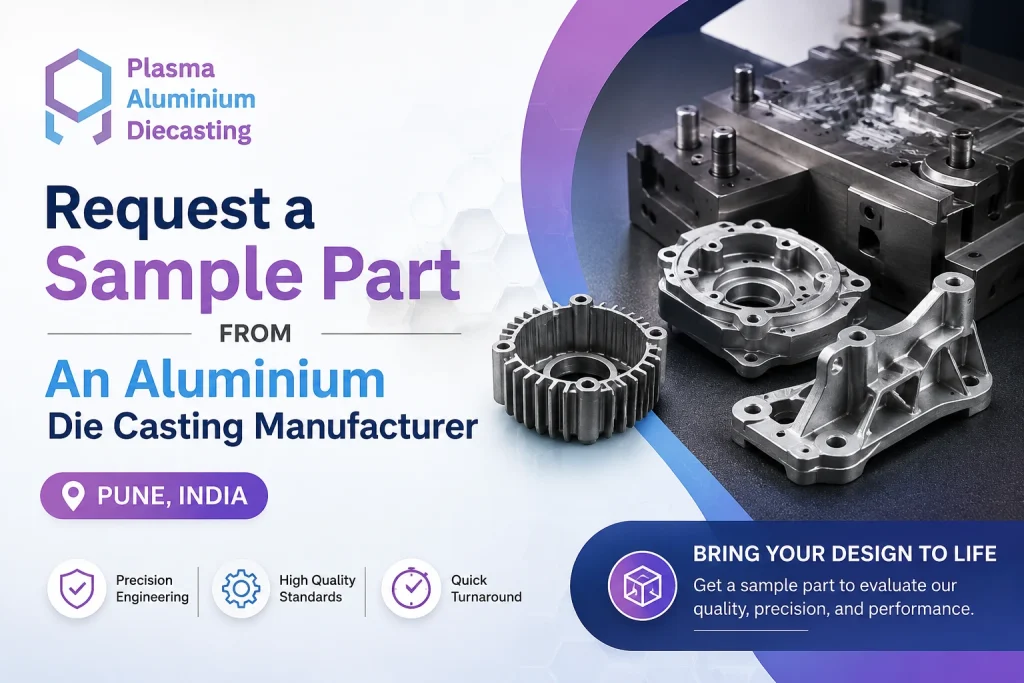
| ► Plasma Aluminium Diecasting provides first-article samples within 6 to 10 weeks of drawing freeze and tooling PO — covering tooling manufacture, trial shots and dimensional inspection report. |
| ► Sample requests require a 3D STEP file and 2D drawing with GD&T; a part sketch with key dimensions is sufficient for a preliminary tooling cost estimate before committing to tooling. |
| ► The sample process includes full first-article inspection (FAI) with dimensional report covering all print-critical dimensions, material certification and a PPAP Level 2 or Level 3 pack on request. |
| ► Sample quantity from first trial shots is typically 20 to 50 pieces — sufficient for customer dimensional verification, fit checks and initial functional testing. |
| ► There is no separate sample charge; the tooling purchase order covers tooling manufacture including the first-article trial shots and dimensional report. |
| ► For customers evaluating Plasma Aluminium Diecasting without an immediate production programme, a DFM review of the part design is available as a free pre-commitment service — identify potential design issues before tooling investment. |
| ► The fastest path to a first sample: freeze drawing, submit 3D STEP and 2D drawing, approve DFM review, place tooling PO — first samples arrive in 6 to 10 weeks. |
SAMPLE PROCESS TIMELINE
| Stage | Activity | Lead Time from Previous Stage | Cumulative |
| Stage 1 | Drawing freeze and customer submission | Customer action | Week 0 |
| Stage 2 | DFM review by Plasma engineering | 3 to 5 working days | Week 1 |
| Stage 3 | DFM approval by customer | 1 to 3 working days | Week 2 |
| Stage 4 | Tooling PO placement by customer | Customer action | Week 2 |
| Stage 5 | Tooling design and steel procurement | 1 to 2 weeks | Week 3 to 4 |
| Stage 6 | Rough CNC machining | 1 to 2 weeks | Week 4 to 6 |
| Stage 7 | Heat treatment + finish machining + EDM | 1 to 2 weeks | Week 5 to 8 |
| Stage 8 | Die assembly + polishing | 3 to 5 working days | Week 7 to 9 |
| Stage 9 | Trial shots + inspection | 2 to 4 working days | Week 8 to 10 |
| Stage 10 | First-article samples dispatched to customer | 1 to 2 working days | Week 9 to 11 |
| Metric | Data | Source |
| Standard tooling lead time to first samples | 6 to 10 weeks from drawing freeze | Industry practice |
| First-article sample quantity | 20 to 50 pieces (from trial shots) | Industry practice |
| DFM review turnaround | 3 to 5 working days | Plasma practice |
| PPAP Level 3 preparation time (post first samples) | 2 to 4 weeks | Industry practice |
| Dimensional report coverage | All print-critical dimensions, GD&T per drawing | Industry practice |
| Sample tooling cost (paid separately from per-piece price) | INR 5 to 50 lakh depending on complexity | Industry estimate |
| Production release lead time after PPAP approval | 1 to 3 working days | Industry practice |
Introduction: Starting a New Programme with Plasma Aluminium Diecasting
Whether you are evaluating Plasma Aluminium Diecasting as a new supplier for an existing production programme or starting a new part design from scratch, the path to first samples is straightforward and well-defined. This post explains every step in the sample process — what information to provide, what you receive at each stage, the timeline you can plan against and the quality documentation that accompanies first samples. Understanding the process upfront removes uncertainty and helps you plan your programme schedule accurately.
What Information to Provide for a Sample Request
The minimum information needed to start the sample process is a 3D STEP file and a 2D drawing with GD&T (geometric dimensioning and tolerancing) callouts on all critical dimensions. If the drawing is not yet finalised, a 3D STEP file alone is sufficient for a preliminary DFM review and tooling cost estimate — the drawing does not need to be fully dimensioned at the enquiry stage.
In addition to geometry information, it helps to provide: the alloy specification (ADC12 or A380 for standard HPDC applications; A356 for LPDC; or a specific IS/ASTM alloy specification); the annual production volume estimate; the surface finish requirements (as-cast, machined, powder coated, anodised); the delivery location (for logistics planning); and any customer-specific quality plan requirements (PPAP level, special characteristics, control plan requirements).
The DFM Review: Before Tooling Commitment
Before any tooling purchase order is placed, Plasma Aluminium Diecasting’s engineering team performs a DFM (design for manufacture) review of the submitted 3D model. The DFM review identifies: draft angle compliance (are all walls draftable for die casting?), wall thickness uniformity (any sections too thin for reliable fill or too thick for controlled solidification?), undercut features (any features requiring side-action slides, adding tooling cost?), parting line location (optimal split for fill, ejection and flash control), and any geometry that requires modification before tooling design begins.
The DFM review is provided free of charge as part of the quotation process. It typically takes 3 to 5 working days. The output is a marked-up 3D model or drawing with recommendations and a revised tooling cost estimate if any DFM changes affect the die complexity. Customers approve the DFM review before the tooling PO is placed.
Tooling Manufacture and Trial Shots
Once the tooling PO is placed, the die is manufactured in Plasma’s or a partner toolroom’s CNC machining and EDM facilities. Standard complexity single-cavity tooling is completed in 6 to 8 weeks. Complex multi-cavity or side-action tooling may require 8 to 12 weeks. The milestones during tooling manufacture are: tooling design approval (1 week), steel procurement (1 week), rough machining (1 to 2 weeks), heat treatment (1 week), finish machining and EDM (1 to 2 weeks), die assembly and polishing (3 to 5 days), trial shots (2 to 3 days).
Trial shots produce the first physical parts from the new tooling. Initial shots verify that the cavity fills completely, that the part ejects cleanly, that cooling is effective and that the visible surface meets quality expectations. Process parameters are adjusted (injection speed, temperature, cycle time) to optimise the shot before first-article inspection parts are produced.
First-Article Inspection and PPAP
First-article inspection measures all print-critical dimensions on 5 to 10 samples using calibrated gauges and CMM. The dimensional report lists each dimension, the nominal value, the tolerance and the measured actual value on each sample. Cpk calculation is performed on key dimensions with tight tolerance. The inspection report is included in the sample delivery package.
If a PPAP (production part approval process) is required, the PPAP package (Level 2 or Level 3) is prepared after first-article approval and covers: dimensional report, material certification, process flow diagram, control plan, FMEA (process FMEA), measurement system analysis, appearance approval and sample retention.
After PPAP: Production Release
Once the customer approves the PPAP and signs off the sample, production is released. First production delivery is typically within 1 to 3 working days of PPAP approval for scheduled production batches. For urgent requirements, same-day or next-day production starts are feasible if machine capacity is available.
FAQ
Q: Can I get a sample from existing tooling without making new tools?
If the part you need matches a geometry that Plasma Aluminium Diecasting has already tooled for another customer, it may be possible to run a trial sample from existing tooling — but this is uncommon because most die cast tooling is customer-specific. For standard commodity parts (simple brackets, covers, standard housings) where a close match exists, contact us and we will check our tooling library.
Q: What is the cost of first-article samples from Plasma?
There is no separate charge for first-article samples — the tooling purchase order covers tooling manufacture, trial shots and first-article inspection report. The only cost is the tooling investment itself. There is no per-piece charge for the first 20 to 50 first-article samples from the trial shot run.
Q: Can we get a sample before committing to production tooling?
The only way to get a true die cast sample in the production alloy and process is from production tooling (a real die). However, if you need a physical part for form/fit check before committing to tooling, we can provide: CNC machined prototype from aluminium billet (same alloy, similar surface but no as-cast characteristics) at lower cost than production tooling. Discuss your prototyping requirement with us at the enquiry stage.
Q: Does Plasma Aluminium Diecasting send samples to customers outside Pune?
Yes. Samples can be dispatched by courier to any location in India. International shipments are also arranged for global OEM customers evaluating Indian die casting supply. DHL, FedEx and India Post express services are all available for sample dispatch. Dispatch time for samples within India is 1 to 3 working days after packing.
Q: What happens if the first sample does not meet dimensions?
If first-article samples are out of tolerance, Plasma’s engineering team identifies the cause (tooling dimensional error, shrinkage compensation needed, parameter issue) and makes the required correction. Die correction is provided at no additional charge if the non-conformance is a tooling error. Process parameter corrections are also made at no charge. A second trial shot is run after correction and new first-article samples are produced.
Conclusion
The sample process for aluminium die casting at Plasma Aluminium Diecasting is clear, documented and customer-oriented: submit drawing and 3D model, receive DFM review in 3 to 5 days, place tooling PO, receive first samples with dimensional report in 6 to 10 weeks. The tooling investment covers all sample costs; there is no separate sample charge. PPAP documentation is prepared after first-article approval for customers with automotive Tier-1 quality requirements. Start your sample request today at
Contact Plasma Aluminium Diecasting at plasmaaluminiumdiecasting
Specifications and pricing vary by order volume, material grade and finish requirements. Contact the team for a detailed technical datasheet and quote.

Prasanna Kumar Tiwari
Plasma Aluminium Diecasting was established after analyzing the worldwide surge in manufacturing demand across diverse sectors — from automobiles to FMCG, Oil & Gas, and Pharma. To meet this growing need, we provide a comprehensive range of precision-engineered products and industrial solutions that streamline production and enhance efficiency. As a Leading Aluminium Die Casting Manufacturer in Pune, our commitment lies in delivering innovative, technology-driven, and cost-effective solutions tailored for modern industries.