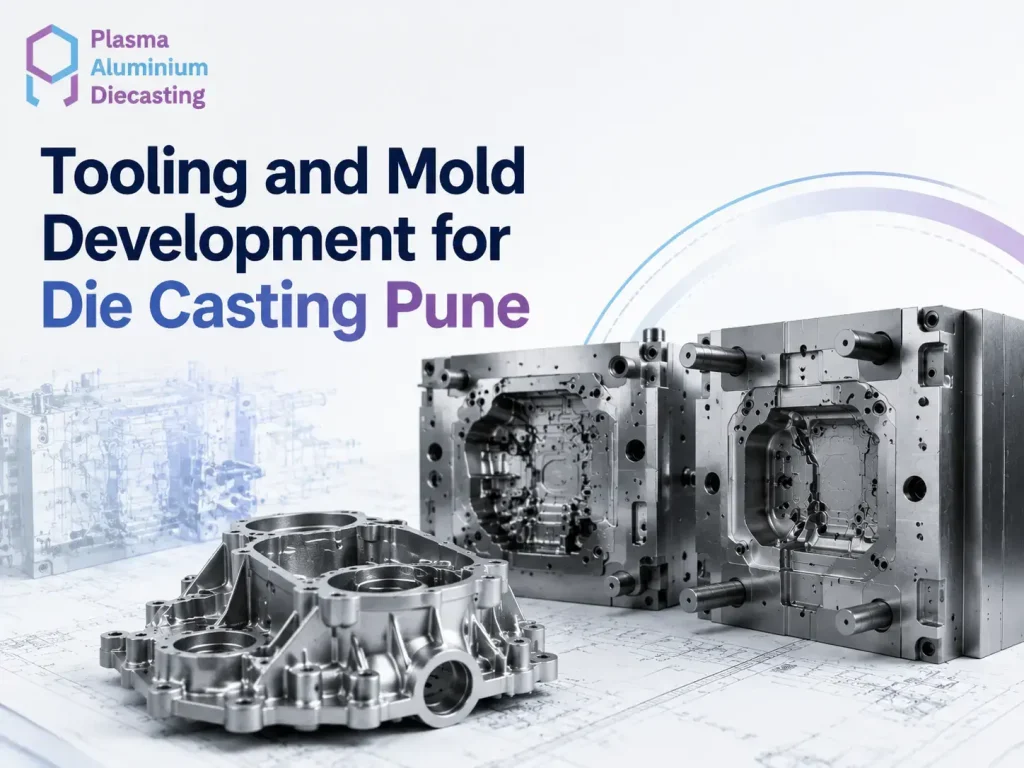
| ► A well-designed H13 steel die lasts 80,000 to 120,000 shots before refurbishment, making tooling the most cost-leveraged investment in any casting programme. |
| ► Single-cavity HPDC die cost in Pune ranges from INR 3 lakh to INR 15 lakh depending on part complexity, core count and required tolerances. |
| ► Die design decisions — gate location, runner geometry, venting — directly control casting porosity, dimensional accuracy and surface finish. |
| ► DFM review before die construction typically reduces tooling cost by 10 to 25 percent by optimising draft angles and wall thickness early. |
| ► Standard tooling lead time from drawing to first sample shots is 4 to 8 weeks; complex multi-cavity tools may take 10 to 12 weeks. |
| ► Correct die temperature control (180 to 250 degrees C for aluminium HPDC) is the single largest variable in part-to-part dimensional consistency. |
| ► Tooling amortised over 200,000 shots adds less than INR 0.50 per part at high volumes, making upfront investment economically sound. |
Introduction: Why Tooling Is the Foundation of Die Casting Quality
Every defect in a die cast aluminium part traces back to one of two sources: process variables during production or design decisions made months earlier when the die was being built. Tooling and mold development for die casting in Pune is not a procurement line item to minimise — it is the engineering investment that determines part accuracy, reject rate and total cost of ownership across the entire production run. This guide explains how die tooling works, what it costs and what procurement teams and engineers should ask before committing to a supplier.
| Parameter | Value |
| Tooling material | H13 hot-work tool steel (standard); H11 for lower-volume GDC |
| Single-cavity HPDC die cost | INR 3 lakh to INR 15 lakh depending on complexity |
| Tooling lead time | 4 to 8 weeks (standard); 10 to 12 weeks (complex) |
| Expected tool life (H13, HPDC) | 80,000 to 120,000 shots before refurbishment |
| Die operating temperature | 180 to 250 degrees C for aluminium HPDC |
| DFM review turnaround | 24 to 72 hours from drawing receipt |
| Metric | Data | Source |
| India die casting tooling market size 2024 | USD 620 million (est.) | Industry estimate |
| Tooling share of total casting programme cost | 15 to 35 percent at low volume | Industry estimate |
| Pune-area tooling and die shops | 120+ registered units | CII Pune 2024 |
| H13 tool steel consumption India 2024 | 38,000 metric tonnes (est.) | IBEF Metals Report 2024 |
| Average DFM cost saving when applied | 10 to 25 percent tooling reduction | Industry estimate |
| CAGR India precision tooling 2024-2029 | 8.1 percent | Industry estimate |
| Make in India PLI tooling component outlay | INR 6,238 crore | Ministry of Heavy Industries 2023 |
How Die Tooling Works: From Drawing to First Shot
Die tooling begins with the 3D CAD model of the finished casting. A die designer analyses the part geometry and determines how to split the cavity between the fixed cover half and the moving ejector half of the die. Gate location — where molten metal enters the cavity — is selected to achieve complete fill without cold shuts or turbulence. Runner geometry and overflow wells trap the leading cold metal away from finished surfaces.
Die blocks are CNC machined from annealed H13 steel billets, with cavity faces finished to the required Ra value. Cores for internal features, lifters for undercuts and cooling channels are then machined and fitted. The assembled die is heat-treated to 44 to 48 HRC hardness for HPDC service, trial-shot to verify fill pattern and dimensionally checked against the drawing before T1 samples are submitted for customer approval.
Key Design Decisions That Determine Part Quality
| Design Decision | Impact on Part Quality | Common Error |
| Gate location | Controls fill pattern and porosity distribution | Gate too small — high velocity turbulence and porosity |
| Draft angle on walls | Controls part release without distortion | Insufficient draft — die damage on ejection |
| Wall thickness uniformity | Controls shrinkage and sink marks | Abrupt thick-to-thin transitions |
| Cooling channel layout | Controls die temperature and cycle time | Channels too far from cavity — uneven cooling |
| Venting and overflow wells | Allows gas escape during fill | Under-vented die — porosity in thick sections |
| Ejector pin layout | Distributes ejection force evenly | Pins on thin features — distortion on ejection |
Tooling Cost Breakdown: What You Are Paying For
| Cost Component | Typical Share | Notes |
| H13 steel (fixed and ejector halves) | 25 to 35 percent | Material grade and billet size drive cost |
| CNC machining (roughing and finishing) | 30 to 40 percent | Most time-intensive component |
| EDM for complex features | 5 to 15 percent | Required for sharp corners and fine details |
| Heat treatment (hardening and tempering) | 4 to 8 percent | Critical for die life; cannot be skipped |
| Assembly, fitting, water connections | 6 to 10 percent | Skilled fitting time |
| Trial shots and T0-T1 corrections | 8 to 15 percent | Reduces with good DFM upfront |
Tooling Life and Preventive Maintenance
H13 steel HPDC dies treated to 44 to 48 HRC typically last 80,000 to 120,000 shots before thermal fatigue cracking appears on the cavity face. Preventive maintenance at 10,000 to 20,000-shot intervals — cleaning cooling channels, checking ejector pin wear, polishing cavity faces, repairing minor cracks by TIG welding — extends die life by 20 to 40 percent compared to run-to-failure practices. Shot-count tracking is non-negotiable for programmes with long production horizons.
DFM Review: Why Involve the Toolmaker Before Freezing the Design
Design for manufacture review at the casting supplier before the drawing is frozen consistently delivers cost savings and faster programme timelines. Common DFM findings in aluminium High Pressure Die Casting include wall thickness below 1.0 mm in non-critical areas, draft angles under 1.5 degrees on deep pockets, and sharp internal corners that require expensive EDM and reduce die life. A DFM review by Plasma’s tooling team is typically completed within 24 to 72 hours of receiving the 3D CAD file.
Plasma Aluminium Diecasting‘s Tooling Capability Near Chakan
Plasma’s in-house tooling workshop near Chakan MIDC serves buyers across the Pune industrial belt — Chakan, Talegaon, Ranjangaon and Moshi. Proximity matters for tooling programmes because engineering change loops move faster when the toolmaker is 30 minutes away rather than in another city. OEM programmes in the Chakan cluster frequently require tooling modifications mid-programme as vehicle design evolves, and Plasma can action an engineering change notice within days and submit revised T1 samples without the 3 to 6-week round-trip that distant tooling suppliers require.
FAQ: Tooling and Mold Development for Die Casting
Tooling is typically owned by the buyer who pays for it, even when housed at the casting facility. Ownership, transfer rights and buyback terms must be documented in the purchase order before work begins.
Yes. Tooling transfer is standard when changing casting suppliers. Plasma inspects transferred dies, assesses condition, makes necessary repairs and runs T1 samples before committing the tool to production. Transfer inspection typically completes within 5 to 7 working days.
A 3D STEP or IGES file plus a 2D drawing with all GD&T callouts, alloy specification and annual volume forecast are the minimum requirements. Post-casting CNC requirements and pressure test requirements should also be included if applicable.
If a die fails before its quoted shot life under normal operating conditions, the toolmaker is typically expected to repair it at no cost or at a discounted rate. Tooling warranty terms should be agreed in writing before the purchase order is placed.
A 2-cavity die costs approximately 1.6 to 1.8 times a single-cavity die because of the additional steel and machining time, but halves the per-part cycle time. Lead time increases by 1 to 2 weeks. Multi-cavity tooling makes economic sense at annual volumes above 50,000 units where press time is the bottleneck.
Conclusion
Tooling and mold development for die casting in Pune is the engineering foundation on which every subsequent part is built. Quality H13 tooling, thorough DFM review and disciplined maintenance scheduling return their cost many times over through lower scrap rates, tighter tolerances and extended die life. For buyers in Pune’s Chakan, Talegaon and Ranjangaon clusters, working with a casting supplier who owns the tooling workshop gives programme teams the responsiveness and accountability they need.
Submit your 3D CAD file, and Plasma’s engineering team will respond with a DFM review and tooling quotation.

Prasanna Kumar Tiwari
Plasma Aluminium Diecasting was established after analyzing the worldwide surge in manufacturing demand across diverse sectors — from automobiles to FMCG, Oil & Gas, and Pharma. To meet this growing need, we provide a comprehensive range of precision-engineered products and industrial solutions that streamline production and enhance efficiency. As a Leading Aluminium Die Casting Manufacturer in Pune, our commitment lies in delivering innovative, technology-driven, and cost-effective solutions tailored for modern industries.